


Summary
Discover why pre‑qualification questionnaires (PQQs) are critical in UK construction procurement, what they include, and how automation boosts supplier compliance.
What Is a PQQ?
- Financial stability
- Health & Safety competence
- Environmental management
- Quality assurance
- Insurances and certifications
Why Do PQQs Matter in UK Construction?
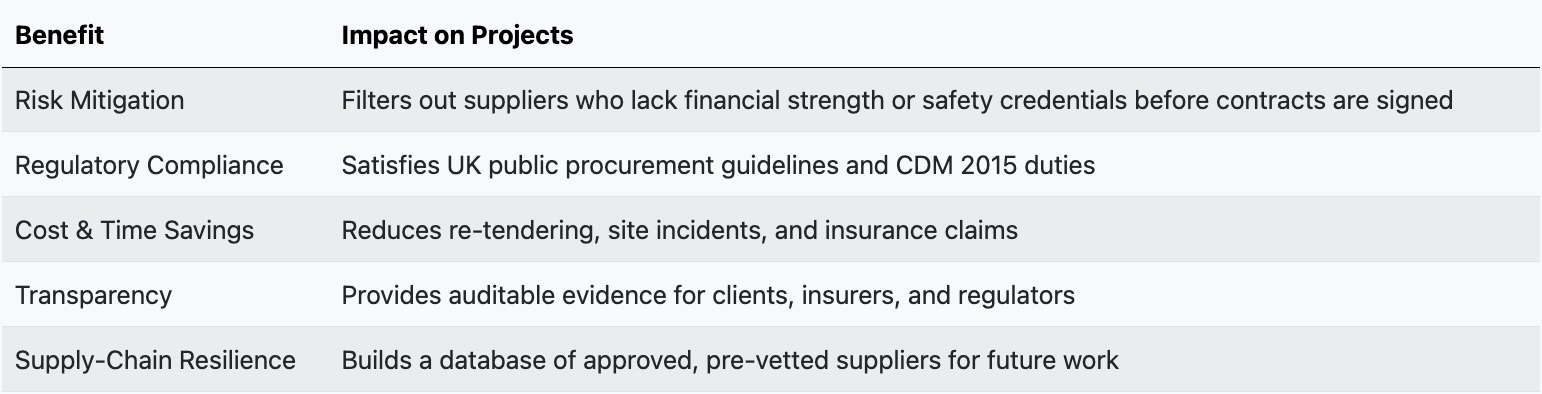
Key Components of a Construction PQQ
- Business Identity & Standing – Company registration, ownership, references.
- Financial Performance – Turnover, profit margin, insurances.
- Health & Safety – Policies, accident records, SSIP certificates.
- Environmental Controls – ISO 14001 or equivalent evidence.
- Quality Management – ISO 9001 or internal QA procedures.
- Equal Opportunities & Diversity – Policies and training logs.
- Optional Modules – BIM capability, modern slavery, CSR initiatives.
How Automation Improves Supplier Compliance
Manual PQQ workflows simply can’t keep pace with modern project timelines. Platforms like Samson by Liaison Systems digitise the entire journey: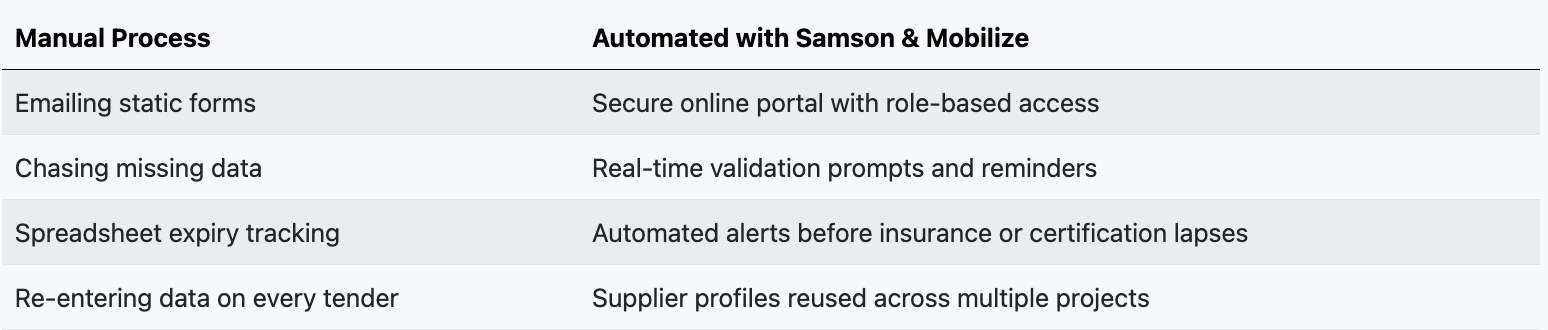
PAS-91 Checklist
We have created a simple checklist based on the British PAS-91 standard to help you to build a pre-qualification questionnaire that will both reduce supply chain risk and ensure you're procuring quality suppliers.
Conclusion: Build Strong Projects on Solid Compliance
A thorough pre‑qualification questionnaire construction strategy cuts risk, boosts transparency, and accelerates mobilisation. Combine that with automation and you gain a competitive edge: projects start sooner, data stays current, and compliance is never in doubt.
Posted on 08 Sep 2025
Related platformMobilize
Supply Chain Management
Mobilize offers a fully customisable suite of tools designed to help you manage your entire supply chain with precision giving you complete visibility and control so that you can reduced risk at every stage, from onboarding through to project review.
Find out more
Tender Prices Could Rise Over 20% by 2029 - What It Means for Your Supply Chain
Construction tender prices could climb by more than a fifth between now and 2029, and crucially much of that cost risk is expected to be retained by the supply chain rather than passed up the chain. That's the headline from analysis by consultancy Arcadis, reported by Construction News. With steel tariffs, geopolitical instability and a new carbon border measure all adding pressure and the cost of tendering itself rising, margins are getting squeezed from both directions. This article breaks down what the forecasts say, why suppliers are most exposed, and the practical steps, including supply chain management technology, that reduce the operational and risk costs inflation brings.

The Difference Between Supplier Compliance and Supplier Performance
Many organisations use the terms supplier compliance and supplier performance interchangeably, but they are not the same thing. A supplier may be fully compliant yet consistently underperform. Likewise, a supplier may deliver excellent work but fail to maintain the required certifications, insurance or compliance documentation. Understanding the difference is critical for organisations looking to reduce risk, improve project outcomes and build stronger supply chains. The most successful supply chain management strategies focus on both compliance and performance because one without the other can still expose a business to significant risk.

Common Assessment Standard for Buyers and Main Contractors
For buyers and main contractors, the Common Assessment Standard (CAS) is a tool for de-risking your supply chain: one industry-agreed pre-qualification standard that lets you assess every supplier on a consistent basis, refreshed annually and shared across assessment bodies. This guide covers how to mandate CAS across your supply chain, what level to require, how to handle building safety obligations, and how to monitor compliance at scale without drowning your team in admin.