


Summary
Sustainability is no longer a "nice to have" in construction. Clients, investors, regulators and supply chain partners are increasingly expecting organisations to understand and reduce their environmental impact. For many businesses, this starts with measuring carbon emissions. However, carbon reporting is often more complex than simply looking at fuel usage or electricity bills. To build a complete picture, organisations need to understand Scope 1, Scope 2 and Scope 3 emissions. Whilst these terms are becoming increasingly common in tenders and sustainability reports, many organisations are still unsure what they actually mean, or why they matter. Understanding the differences is the first step towards making better decisions, improving reporting and building a more sustainable construction industry.
What Are Scope 1, Scope 2 and Scope 3 Emissions?
The Greenhouse Gas Protocol divides emissions into three categories, known as Scope 1, Scope 2 and Scope 3.
Together, they provide a framework for measuring an organisation's carbon footprint.
Each scope represents a different source of emissions and requires a different approach to measurement and reporting.
Scope 1 – Direct Emissions
Scope 1 emissions are those that come directly from sources owned or controlled by your organisation.
Examples in construction include:
- Fuel used by company owned vehicles
- Diesel generators on site
- Gas used for heating offices or depots
- Fuel consumed by owned plant and machinery
These emissions are often the easiest to measure because organisations usually have direct access to the relevant fuel and energy data.
Reducing Scope 1 emissions might involve:
- Switching to electric vehicles
- Using lower emission plant
- Reducing fuel consumption
- Improving operational efficiency
Scope 2 – Indirect Energy Emissions
Scope 2 emissions relate to the electricity, heating or cooling that an organisation purchases.
Although the emissions occur where the energy is generated rather than where it is used, organisations remain responsible for the energy they consume.
Examples include:
- Office electricity
- Depot electricity
- Temporary site accommodation
- Site welfare facilities
- Charging electric vehicles
Many organisations reduce Scope 2 emissions by:
- Purchasing renewable electricity
- Improving energy efficiency
- Installing LED lighting
- Investing in solar generation
- Improving building performance
Scope 3 – The Biggest Challenge
For many construction businesses, Scope 3 emissions represent the largest proportion of their overall carbon footprint.
Scope 3 includes emissions that occur throughout the wider value chain.
Examples include:
- Purchased construction materials
- Subcontractors
- Supplier operations
- Business travel
- Employee commuting
- Waste disposal
- Material transportation
- Product manufacturing
- End-of-life disposal
Unlike Scope 1 and Scope 2, organisations often have less direct control over these emissions.
However, they still have the ability to influence them through procurement decisions, supplier engagement and better supply chain management.
Why Scope 3 Is Becoming Increasingly Important
Historically, many organisations focused primarily on Scope 1 and Scope 2 because they were easier to measure.
Today, clients increasingly expect businesses to understand the emissions generated throughout their supply chain.
This is particularly relevant in construction, where purchased materials and subcontracted services can account for a significant proportion of a project's overall carbon impact.
Questions increasingly seen during procurement include:
- Do you have a Carbon Reduction Plan?
- How do you measure Scope 3 emissions?
- How do you engage suppliers on sustainability?
- What environmental information do you collect from your supply chain?
The ability to answer these questions is becoming an important competitive advantage.
Better Data Leads to Better Decisions
One of the biggest challenges in carbon reporting is data quality.
Many organisations still collect sustainability information using:
- Spreadsheets
- Email requests
- Paper forms
- Individual supplier documents
This makes reporting difficult and limits visibility across the supply chain.
By centralising supplier information and sustainability data, organisations gain a clearer understanding of where emissions originate and where improvements can be made.
As with many business decisions, better data leads to better outcomes.
Carbon Reporting Is About More Than Compliance
Whilst reporting requirements continue to evolve, measuring emissions should not simply be viewed as a compliance exercise.
Understanding carbon emissions helps organisations:
- Identify opportunities to reduce costs
- Improve operational efficiency
- Support sustainability objectives
- Strengthen procurement decisions
- Meet client expectations
- Demonstrate environmental leadership
Carbon reporting provides valuable insight that can support both commercial and environmental goals.
How Supply Chain Management Supports Scope 3 Reporting
Because Scope 3 emissions largely originate from suppliers and subcontractors, supply chain management plays a vital role in improving carbon reporting.
Organisations that maintain accurate supplier information are better positioned to:
- Collect sustainability information consistently
- Monitor supplier commitments
- Record environmental certifications
- Assess carbon reduction initiatives
- Improve reporting accuracy
Rather than treating sustainability as a separate function, many organisations are embedding environmental information directly into supplier management processes.
How Mobilize Helps Manage Sustainability Information
Collecting environmental information across hundreds, or even thousands, of suppliers can quickly become a challenge.
Mobilize provides organisations with a structured approach to managing supplier information, helping centralise:
- Supplier questionnaires
- Carbon Reduction Plans
- Environmental policies
- Sustainability commitments
- Certifications
- Compliance documentation
By bringing supplier and sustainability information together into a single platform, organisations gain greater visibility across their supply chain and can support more informed environmental reporting.
Whilst reducing emissions requires action across the business, having accurate and accessible information is an essential first step.
Looking Ahead
The construction industry is under increasing pressure to deliver projects that are not only safe, high quality and cost effective, but also environmentally responsible.
Understanding Scope 1, Scope 2 and Scope 3 emissions helps organisations build a clearer picture of their environmental impact and identify meaningful opportunities for improvement.
The businesses that invest in better carbon reporting today are likely to be better prepared for future client expectations, procurement requirements and sustainability goals.
Conclusion
Recording carbon emissions is becoming an essential part of modern construction.
Whilst Scope 1 and Scope 2 emissions remain important, many organisations are recognising that the greatest opportunities and challenges often lie within Scope 3.
By improving data quality, engaging suppliers and taking a structured approach to sustainability reporting, construction businesses can move beyond compliance and make more informed decisions about the future of their operations.
Because understanding your carbon footprint isn't just about measuring emissions.
It's about understanding where meaningful improvements can be made.

Posted on 15 Jul 2026
Related platformMobilize
Supply Chain Management
You’re chasing suppliers for certificates that expired last month. Mobilize onboards them once, then keeps insurance, accreditations and PQQ answers current automatically, so you know who is approved before you tender.
Find out more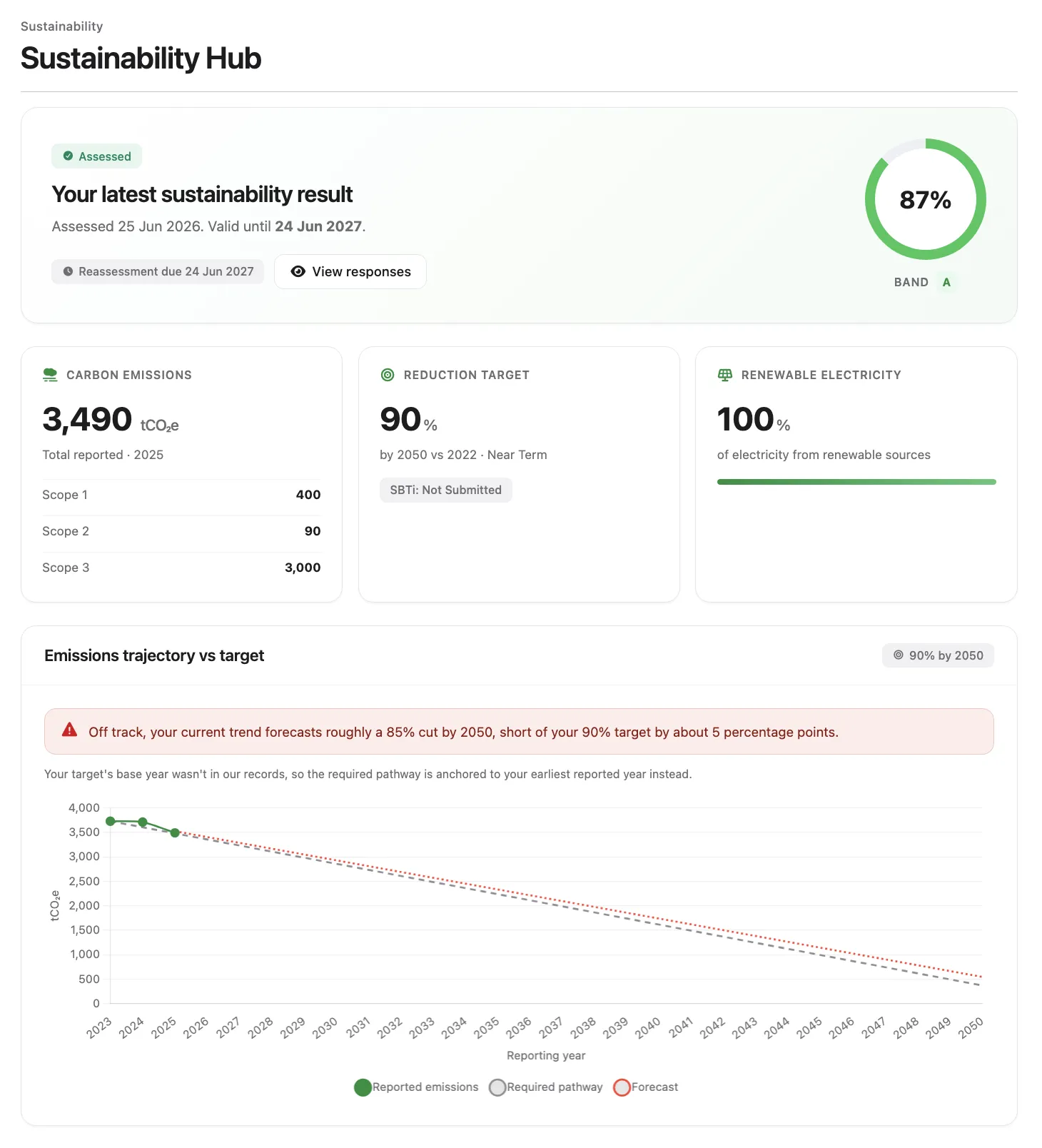
How to Complete the Mobilize Sustainability Assessment
Sustainability is becoming an increasingly important part of doing business in construction. Whether you're responding to a pre-qualification questionnaire (PQQ), working towards Net Zero or strengthening your environmental credentials, clients are increasingly asking suppliers to demonstrate their sustainability performance. The Mobilize Sustainability Assessment has been designed to make that process simple. Rather than completing different sustainability questionnaires for multiple clients, suppliers complete a single structured assessment that measures their sustainability performance, records supporting evidence and provides instant feedback on where they are performing well and where improvements can be made. The same assessment can then be viewed by participating supply chain owners, reducing duplicated effort. In this guide, we'll explain how to register, complete your assessment and make the most of the information it provides.

Why Carbon Data Is Only as Good as the Information Behind It
As sustainability becomes a greater priority across the construction industry, organisations are investing more time and resources into measuring their carbon emissions. From Carbon Reduction Plans to Scope 1, Scope 2 and Scope 3 reporting, businesses are gathering more environmental data than ever before. But there is one question that often gets overlooked: Can you trust the data you're reporting? After all, even the most ambitious sustainability strategy is only as good as the information it's built on. If your carbon data is incomplete, inconsistent or out of date, the decisions you make and the reports you produce may not reflect the true environmental impact of your business.
Why Most Net Zero Strategies Fail Before They Reach the Supply Chain
Over the past few years, net zero has moved from a sustainability initiative to a boardroom priority. Businesses are measuring carbon emissions, publishing carbon reduction plans and setting ambitious net zero targets. Yet many organisations still struggle to achieve meaningful progress. The reason is surprisingly simple. Most net zero strategies focus heavily on internal operations while overlooking the area that often contributes the largest share of emissions: the supply chain. For many organisations, particularly in construction, facilities management and infrastructure, supplier-related emissions can account for the majority of their overall carbon footprint. Until businesses gain visibility of their supply chains, meaningful carbon reduction will remain difficult to achieve.