


Summary
Your subcontractor passed their PQQ and joined your approved supplier list. But what happens six months later when their insurance expires, an accreditation lapses or their financial position deteriorates? Approval is only a snapshot of a supplier's position at a particular moment. We explore why ongoing subcontractor monitoring matters and how main contractors can reduce the risks hiding in their approved supply chains.
Approved Doesn't Always Mean Compliant
Your subcontractor completed their pre-qualification questionnaire.
Their insurance certificates were valid. Their accreditations were in place. Their financial information was reviewed and they met your company's requirements.
They passed the assessment and were added to your approved supplier list.
Six months later, they're still on that list.
But are they still compliant?
Their public liability insurance may have expired. An accreditation might have lapsed. Their financial circumstances could have changed significantly.
And unless someone has been checking, your procurement team might not know.
This is one of the biggest weaknesses in traditional subcontractor approval processes.
A PQQ tells you whether a supplier met your requirements when they were assessed.
It doesn't guarantee that they'll continue meeting those requirements indefinitely.
For main contractors managing hundreds or even thousands of subcontractors, that distinction matters.
The Problem With Treating Supplier Approval as a One-Off Exercise
Pre-qualification questionnaires are an important part of construction supply chain management.
They help contractors assess whether prospective suppliers meet the necessary standards before being appointed.
Depending on the work involved, this may include reviewing:
- Insurance coverage
- Health and safety arrangements
- Relevant accreditations and certifications
- Financial information
- Technical competence
- Experience and previous projects
- Environmental and quality management arrangements
But much of this information has a limited period of validity.
Insurance policies renew annually.
Certifications and accreditations have expiry dates.
Financial circumstances change.
Staff, qualifications and operational capabilities can change too.
A subcontractor that satisfied every requirement in January might not satisfy those same requirements in October.
The issue isn't necessarily that the supplier has done anything wrong.
It's that the information used to approve them may no longer reflect their current position.
1. Insurance Can Expire Without Anyone Noticing
Insurance is one of the clearest examples of why ongoing supplier monitoring matters.
A subcontractor might provide valid public liability and employers' liability insurance certificates during pre-qualification.
Those documents are reviewed and approved.
But what happens when the policies expire?
If the contractor doesn't obtain and review the renewal documents, the subcontractor may remain marked as approved despite the original evidence no longer being current.
There is also an important distinction between an expired certificate and an uninsured business.
An expired certificate does not automatically prove that insurance cover has ended. The supplier may have renewed their policy without submitting the new evidence.
However, until the current position has been verified, the contractor may be unable to demonstrate that its insurance requirements are being met.
This can create unnecessary risk, particularly where subcontractors are carrying out high-risk activities.
For procurement and supply chain teams, the challenge is ensuring that insurance renewals are tracked, checked and recorded without relying on someone manually reviewing hundreds of individual files.
2. Accreditations and Certifications Don't Last Forever
Many construction contractors rely on accreditations and certifications as part of their supplier approval criteria.
These may include relevant health and safety assessments, quality management certifications, environmental certifications or specialist industry accreditations.
A supplier might hold the required certification when completing their PQQ.
But certifications can expire, be suspended or be withdrawn.
The requirements can also change over time.
For example, a contractor may introduce additional approval requirements for suppliers undertaking particular types of work.
If the approved supplier list isn't regularly reviewed, it may contain businesses whose evidence no longer meets the contractor's current standards.
This creates an important question:
Is the subcontractor approved because they currently meet your requirements, or because they met them at some point in the past?
Those are two very different things.
3. Financial Stability Can Change Quickly
Financial information is another area where a one-off assessment has limitations.
A subcontractor may appear financially stable when first approved.
However, construction businesses operate in an environment where cash flow pressures, delayed payments, rising costs and project disruption can have significant consequences.
A supplier might experience financial difficulties months after their original assessment.
Warning signs could include:
- Repeated requests for earlier payment
- Increasing difficulty meeting programme commitments
- Delays in paying their own suppliers
- Reduced workforce availability
- Changes in trading arrangements
- Adverse changes in financial information
Not every warning sign means that a subcontractor is approaching insolvency.
However, taken together, they may justify a closer review.
For main contractors, supplier financial difficulties can have consequences beyond the individual subcontractor.
If a critical supplier is unable to continue working, the project may face delays, additional procurement costs and disruption to other trades.
A PQQ completed twelve months earlier is unlikely to provide a complete picture of the supplier's current financial position.
This is why financial risk needs to be considered throughout the supplier relationship, not simply at the point of approval.
4. A Compliant Supplier Isn't Necessarily a Good Performer
Supplier compliance and supplier performance are closely related, but they measure different things.
Compliance helps establish whether a subcontractor meets the requirements for undertaking particular work.
Performance considers how effectively that subcontractor delivers.
For example, a supplier might have valid insurance, current certifications and all the necessary policies.
But what if they repeatedly miss deadlines?
What if the quality of their work is poor?
What if they regularly require additional supervision or fail to resolve defects?
These issues might not automatically make the supplier non-compliant, but they should influence future procurement decisions.
An effective approved supplier process therefore needs to consider both compliance and performance.
This could include reviewing:
- Quality of completed work
- Programme performance
- Health and safety performance
- Communication and responsiveness
- Management of defects
- Commercial performance
- Previous project assessments
The aim isn't simply to determine whether a supplier can be used.
It's to help procurement teams make better-informed decisions about which suppliers should be used.
5. The Approved Supplier List Can Become Outdated
For many contractors, the approved supplier list is treated as a reliable source of information.
Project teams use it to identify subcontractors.
Estimators use it when preparing enquiries.
Procurement managers use it when selecting businesses for upcoming work.
But the value of that list depends entirely on the information behind it.
Imagine a contractor with 500 approved subcontractors.
Some were assessed last month.
Others were approved two years ago.
Insurance certificates have different renewal dates. Accreditations expire at different times. Financial information may have been submitted at different points.
If all 500 businesses simply appear as 'Approved', how can the person selecting a subcontractor distinguish between those with current evidence and those requiring further checks?
An approved list can create a false sense of security when its status is not supported by up-to-date information.
And the larger the supply chain becomes, the harder that information is to maintain manually.
6. Why Manual Monitoring Becomes Difficult at Scale
For a contractor managing a small number of subcontractors, checking renewal dates in a spreadsheet may initially seem manageable.
But the workload grows quickly.
Consider 300 approved suppliers, each with several documents that need periodic review.
That could mean hundreds of separate renewal dates to monitor throughout the year.
Someone needs to identify approaching expiries, contact the supplier, request updated information, review the replacement documents and update the supplier's status.
If the information is held across spreadsheets, emails and shared folders, it becomes difficult to maintain a consistent process.
The problem isn't necessarily a lack of effort from procurement teams.
It's that manual processes become increasingly difficult to manage as the number of suppliers and requirements grows.
And when teams are busy dealing with live tenders and projects, routine renewal checks can easily become another administrative task competing for attention.
7. Not Every Expired Document Means a Supplier Should Be Rejected
There is another important side to this issue.
A subcontractor may hold several different certifications, insurance policies and supporting documents.
Not all of them will necessarily be required by every contractor.
For example, a supplier might hold a specialist accreditation for work they undertake elsewhere.
If that accreditation expires, it shouldn't automatically mean they are unsuitable for a contractor that doesn't require it.
The important question is whether the subcontractor continues to meet the specific requirements relevant to the work and the contractor's approval criteria.
This is where effective compliance monitoring becomes more useful than simply flagging every expired document.
A meaningful compliance process should distinguish between:
- Evidence that is mandatory for approval
- Information that is relevant to particular activities
- Documents that are useful but not essential
- Expired information that requires verification
- Actual failures to meet approval requirements
This helps procurement teams focus on genuine compliance concerns rather than unnecessary alerts.
8. What Should Main Contractors Be Checking After Approval?
A practical ongoing supplier review should consider several areas.
Insurance
Are the required policies still valid, with the appropriate levels and types of cover?
Accreditations
Are the certifications relevant to the supplier's work still current and appropriate?
Financial Position
Has anything changed that could affect the supplier's ability to deliver?
Health and Safety
Are the required arrangements and evidence still suitable for the work being undertaken?
Supplier Performance
Has the subcontractor delivered satisfactorily on recent projects?
Changes in Circumstances
Has the supplier changed ownership, trading arrangements, services or other information relevant to its approval?
Outstanding Actions
Are there unresolved issues that should be addressed before the supplier is appointed again?
Not every supplier needs the same level of monitoring.
The frequency and depth of checks should reflect the nature of the work, the level of risk and the contractor's requirements.
A subcontractor undertaking high-risk specialist work may require more extensive checks than a supplier providing a lower-risk service.
The objective is to maintain an accurate understanding of supplier suitability without creating unnecessary administration.
9. How Mobilize Helps Contractors Monitor Their Approved Supply Chain
Liaison's Mobilize platform is designed to help construction businesses manage supplier onboarding, pre-qualification, compliance and performance throughout the supplier relationship.
Rather than treating the PQQ as the end of the process, Mobilize helps contractors maintain visibility of the information supporting supplier approval.
This includes monitoring the documents and requirements that matter to the contractor.
For example, if a subcontractor's required insurance certificate is approaching expiry, the system can send reminders requesting updated evidence.
When replacement documents are submitted, they can be reviewed before the supplier's compliance position is updated.
Importantly, Mobilize considers the requirements relevant to the contractor's PQQ.
This helps avoid unnecessary warnings caused by documents that the supplier holds but that aren't required for that particular contractor's assessment.
Mobilize also supports supplier performance assessments, helping contractors build a clearer picture of how subcontractors perform across projects.
The result is a more informed approach to supplier management.
Instead of relying solely on the fact that a subcontractor passed a questionnaire in the past, procurement teams can review the current evidence supporting their approval.
10. When Did You Last Review Your Approved Supplier List?
For procurement and supply chain managers, this is a useful question to ask.
Not when was the list last updated.
Not when did the last new supplier complete a PQQ.
But when was the entire approved supply chain last reviewed to establish whether the information supporting approval was still valid?
A useful starting point is to ask:
- How many suppliers are currently marked as approved?
- How many have insurance certificates approaching expiry?
- Are any required accreditations no longer current?
- When was financial information last reviewed?
- Are supplier performance assessments being recorded?
- Can project teams easily identify suppliers requiring further checks?
- How much time is spent manually chasing renewal documents?
If the answers are difficult to find, there may be gaps in the existing process.
And those gaps may not become obvious until a problem arises.
Free Review: How Reliable Is Your Approved Supplier List?
If your business manages an approved list of construction subcontractors, Liaison can help you take a closer look at how that list is maintained.
We're offering a free 20-minute review of your current supplier approval and compliance monitoring process.
We'll discuss how your business manages supplier information, tracks expiring documents, reviews ongoing compliance and identifies potential gaps.
The aim is to help you understand where your existing process is working well and where improvements could reduce risk or unnecessary administration.
There's no obligation to change systems.
Just a practical conversation about how your approved supply chain is being managed.
Book your free 20-minute approved supplier list review with Liaison Systems.
Conclusion
Passing a PQQ is an important step in becoming an approved subcontractor.
But it should never be treated as a permanent guarantee of suitability.
Insurance expires. Accreditations lapse. Financial circumstances change. Supplier performance can improve or deteriorate.
For main contractors, the challenge is maintaining confidence in their approved supply chain long after the initial assessment has been completed.
That requires more than a list of businesses that passed a questionnaire at some point in the past.
It requires accurate information, relevant checks and an ongoing understanding of supplier risk.
Because the real question isn't simply whether your subcontractor was compliant when you approved them.
It's whether they still meet your requirements today.

Posted on 04 Nov 2026
Related platformMobilize
Supply Chain Management
You’re chasing suppliers for certificates that expired last month. Mobilize onboards them once, then keeps insurance, accreditations and PQQ answers current automatically, so you know who is approved before you tender.
Find out more
What Is a Construction Supplier Scorecard and What Should You Measure?
How do you know whether a subcontractor has actually performed well? Completing a project doesn't always tell the full story. A construction supplier scorecard helps contractors measure performance across quality, delivery, safety, communication and commercial management. We explore what a supplier scorecard should include, how to score performance fairly and how the results can support better procurement decisions.

Planning Your 2027 Construction Compliance Calendar: What to Prepare for Now
2027 might still feel some way off, but effective compliance management starts long before January. Supplier insurances expire, accreditations need renewing, PQQ information becomes outdated and regulatory requirements continue to evolve. Planning your compliance calendar now can help your business stay ahead of deadlines, reduce supplier risk and avoid the last-minute rush.
How to Complete the Mobilize Sustainability Assessment
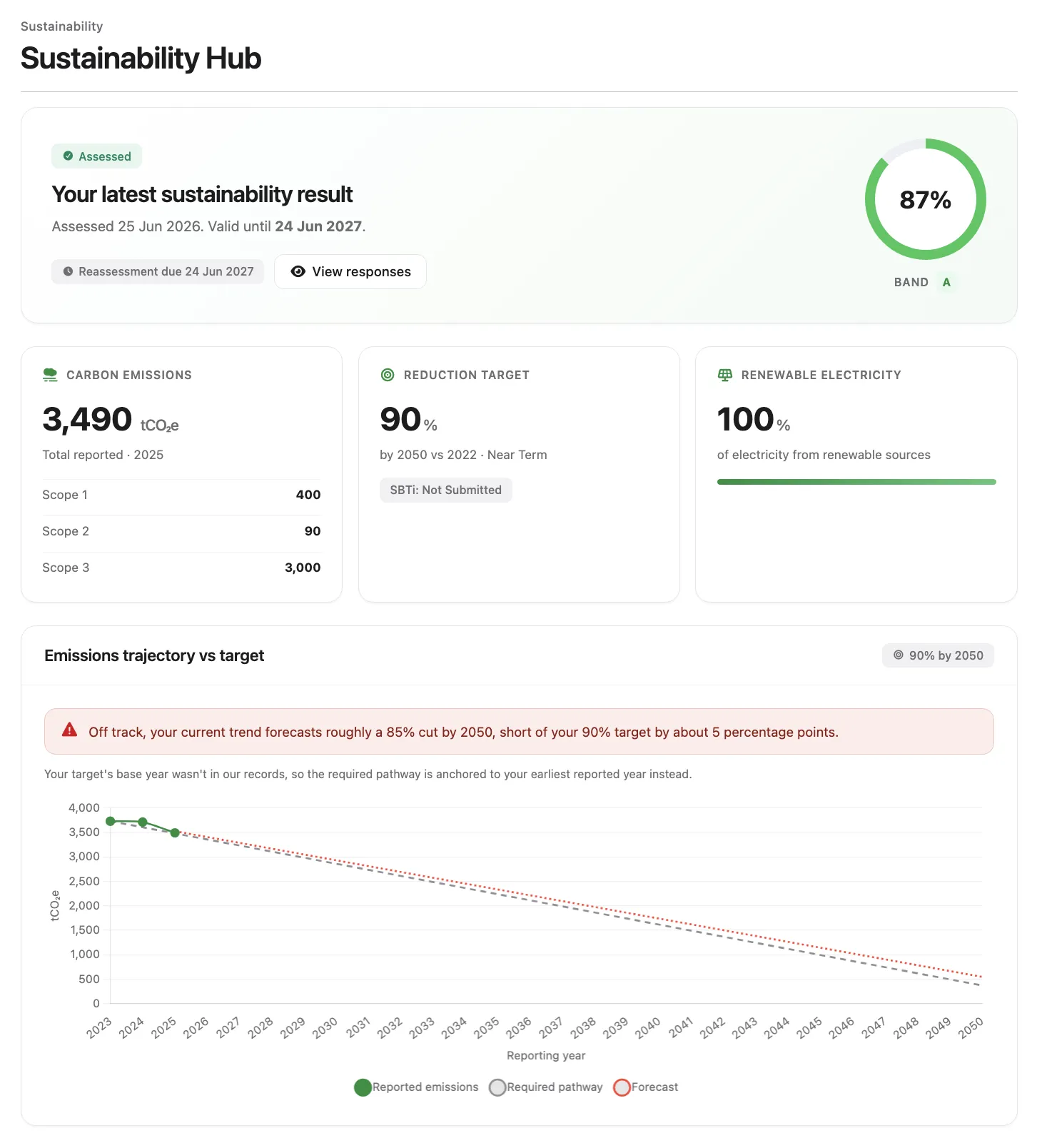
Sustainability is becoming an increasingly important part of doing business in construction. Whether you're responding to a pre-qualification questionnaire (PQQ), working towards Net Zero or strengthening your environmental credentials, clients are increasingly asking suppliers to demonstrate their sustainability performance. The Mobilize Sustainability Assessment has been designed to make that process simple. Rather than completing different sustainability questionnaires for multiple clients, suppliers complete a single structured assessment that measures their sustainability performance, records supporting evidence and provides instant feedback on where they are performing well and where improvements can be made. The same assessment can then be viewed by participating supply chain owners, reducing duplicated effort. In this guide, we'll explain how to register, complete your assessment and make the most of the information it provides.