


Summary
Excel is often where construction supplier management begins. But as subcontractor numbers grow, tracking insurance renewals, accreditations, approval statuses and supplier information can become increasingly difficult. We explore the warning signs that your business may have outgrown spreadsheets, when Excel is still sufficient and what to consider before investing in supplier compliance software.
Excel Worked When You Had 30 Subcontractors. What About 300?
Most construction businesses don't start with dedicated supplier management software.
They start with a spreadsheet.
A list of subcontractors, their contact details, trades, insurance expiry dates and whether they've completed their pre-qualification questionnaire.
It's familiar, inexpensive and straightforward to update.
For a small supply chain, it can work perfectly well.
But as the business grows, so does the spreadsheet.
More subcontractors. More projects. More insurance renewals. More accreditations to check. More people relying on the information.
Before long, the procurement team is managing multiple worksheets, shared folders and email reminders just to establish which subcontractors are approved.
And the question becomes less about whether Excel can store the information.
It's whether your team can still rely on that information when making procurement decisions.
The Problem Isn't Excel. It's What You're Asking It to Do.
Excel is an extremely capable tool.
It can organise supplier information, calculate expiry dates, highlight missing records and produce useful reports.
With the right setup, spreadsheets can even support automated processes.
But a spreadsheet is not automatically a complete supplier compliance management system.
For construction businesses, compliance management involves more than maintaining a list of documents.
Someone needs to collect information, review it, decide whether it meets the contractor's requirements, monitor changes and make that information available to the people selecting subcontractors.
The difficulty grows when those processes depend on different people manually updating different records.
A spreadsheet may tell you that a subcontractor's insurance expires next month.
But who contacts the supplier?
Who checks the replacement certificate?
Who confirms the required cover is in place?
And who updates the supplier's approval status?
If those steps rely on separate emails and manual follow-ups, the spreadsheet is only one part of a much larger process.
1. You're Spending More Time Chasing Documents Than Reviewing Them
One of the first signs that your supplier compliance process is becoming difficult to manage is the amount of time spent requesting information.
Insurance renewals are a good example.
A subcontractor's public liability insurance is approaching expiry.
Someone identifies the date, sends a reminder and waits for a response.
If the supplier doesn't reply, another email is sent.
When the new certificate arrives, someone needs to check it, save it and update the spreadsheet.
Now multiply that process across hundreds of suppliers.
Even when the individual tasks are straightforward, the combined administrative workload can become significant.
The issue isn't simply the number of documents.
It's the time spent coordinating the process around them.
A dedicated supplier compliance system can help by tracking renewal dates, issuing reminders and providing a structured process for suppliers to submit updated information.
That allows procurement teams to spend more time reviewing the evidence that matters rather than repeatedly chasing it.
2. You Can't Easily Tell Who Is Compliant Today
An approved supplier list is only useful if the approval information is current.
Imagine opening a spreadsheet containing 400 subcontractors.
Each has an approval status.
Some were assessed recently.
Others completed their PQQ more than a year ago.
Several have insurance certificates approaching expiry and a few have outstanding accreditation renewals.
How quickly can you identify which suppliers currently meet your requirements?
More importantly, can your estimators and project teams see the same information?
A subcontractor may have passed their original PQQ but no longer have current evidence supporting that approval.
Alternatively, they may have submitted new documents that are still awaiting review.
Those situations shouldn't necessarily be treated as identical.
An effective compliance process needs to distinguish between suppliers who meet the requirements, those awaiting assessment and those with outstanding issues.
If your spreadsheet only shows 'Approved' or 'Not Approved', it may not provide enough information for confident procurement decisions.
3. Different Teams Are Working From Different Versions
Spreadsheets become particularly challenging when several departments rely on supplier information.
Procurement may maintain the master list.
Estimators may download a copy for tendering.
Project managers may keep separate records for subcontractors working on site.
Someone updates an insurance expiry date in one file, but the other copies remain unchanged.
Suddenly, different teams are making decisions using different information.
Cloud-based spreadsheets and shared access can reduce this problem, but they still require clear processes, permissions and controls.
The important question is whether everyone is working from a reliable, current record.
If your procurement team regularly receives questions about which spreadsheet is the latest version, it's worth reviewing how supplier information is managed.
4. Supplier Approval Depends on Someone Remembering to Check
In many businesses, supplier compliance is maintained through the knowledge and experience of a small number of people.
They know which subcontractors need chasing.
They remember which accreditations are required.
They know which suppliers have outstanding issues.
But what happens when they're on annual leave?
Or when a new member of staff joins the procurement team?
If the process depends heavily on individual knowledge, it can become difficult to maintain consistently.
A reliable supplier approval process should make the requirements, responsibilities and outstanding actions clear.
It shouldn't depend on one person remembering that a particular subcontractor needs an updated document before their next appointment.
5. Every Expired Document Creates Another Warning
There's another problem that can emerge when spreadsheets become more sophisticated.
It's possible to build formulas that highlight expired documents.
But an expired document doesn't always mean a subcontractor is non-compliant.
Consider a supplier that holds several accreditations for different clients.
One expires, but your business doesn't require that accreditation for the work the supplier undertakes.
Should that automatically affect their approval?
Not necessarily.
The important question is whether the subcontractor continues to meet your specific requirements.
A useful supplier compliance process needs to understand which documents are mandatory, which are relevant to particular activities and which are simply additional information.
Without that distinction, procurement teams can spend time investigating warnings that don't actually affect supplier suitability.
The aim isn't to flag every expired document.
It's to identify the information that genuinely matters to your business.
6. You're Struggling to Track Why a Supplier Was Approved
A supplier's approval status is only part of the picture.
It's also important to understand how that decision was reached.
Who reviewed the PQQ?
Which documents were accepted?
Were any conditions attached to the approval?
Was additional information requested?
Has the supplier been reassessed since the original decision?
These details can become difficult to follow when they are spread across spreadsheets, email conversations and document folders.
A structured supplier management process helps maintain a clearer record of assessments, decisions and supporting information.
This can be particularly valuable when approval decisions need to be reviewed or explained.
7. Your Supply Chain Is Growing Faster Than Your Administration Team
A business doesn't need thousands of subcontractors before its supplier management process becomes difficult.
Even a few hundred suppliers can create substantial work when each has multiple documents, renewal dates and assessment requirements.
The challenge becomes greater when the business is also managing several projects, different work packages and changing supplier requirements.
At this point, the organisation may face a choice.
Continue adding manual administrative capacity or invest in a more structured approach.
The right answer depends on the business.
But it's worth considering whether the current process will still be manageable if the approved supplier list grows by another 25% or 50%.
A system that works for today's supply chain may not be suitable for the next stage of growth.
8. You Can't Quickly Produce a Reliable Compliance Report
Imagine a director asks:
'How many of our approved subcontractors currently meet all our insurance requirements?'
Or a project manager wants to know:
'Which electrical subcontractors are approved and available for consideration on this project?'
How long would it take to provide a reliable answer?
If the procurement team needs to cross-reference several spreadsheets, search through emails and manually check documents, reporting can become time-consuming.
And by the time the information has been assembled, some of it may already have changed.
A well-managed supplier compliance system should make it easier to access current information and identify outstanding issues.
For decision-makers, that visibility is often more valuable than simply having all the supplier documents stored somewhere.
When Is Excel Still the Right Choice?
Not every construction business needs dedicated supplier compliance software.
For a smaller contractor with a limited, stable supply chain, a well-maintained spreadsheet may be sufficient.
Excel can remain a practical choice where:
- Supplier numbers are relatively low.
- Approval requirements are straightforward.
- Document renewals are manageable.
- Only a small number of people need access.
- Clear processes exist for reviewing and updating information.
- The business can reliably identify which suppliers meet its requirements.
The important point is that the process works.
Buying software simply because spreadsheets are considered outdated isn't a good reason to invest.
The decision should be based on whether the current approach is creating unnecessary administration, limiting visibility or increasing the risk of incorrect supplier decisions.
What Should Supplier Compliance Software Actually Do?
If your business is considering moving beyond spreadsheets, the next step is to identify which capabilities would make a meaningful difference.
For construction supply chains, these may include:
Supplier Onboarding and PQQs
A structured process for collecting and assessing the information needed before suppliers are approved.
Document Expiry Monitoring
Visibility of insurance and accreditation renewal dates, with reminders to help keep information current.
Configurable Approval Requirements
The ability to assess suppliers against the criteria relevant to your business rather than using the same requirements for every supplier.
Supplier Approval Statuses
Clear information about which suppliers are approved, awaiting assessment or require further action.
Centralised Supplier Records
A consistent location for supplier information, supporting documents and assessment records.
Reporting
The ability to identify compliance gaps, outstanding reviews and supplier information without manually compiling multiple spreadsheets.
Supplier Performance Assessments
A way to record how subcontractors perform on projects, helping procurement teams make better-informed decisions about future appointments.
Tendering and Procurement
Where required, the ability to use supplier information as part of the wider tendering and procurement process.
Not every platform offers all these capabilities.
Before choosing a system, ask providers to demonstrate the processes that matter most to your business.
The Real Cost of Managing Supplier Compliance in Excel
Excel itself may already be included in your organisation's software subscriptions.
But the cost of managing supplier compliance isn't limited to the price of the spreadsheet.
Consider the time spent:
- Chasing expired insurance documents
- Reviewing and updating supplier records
- Searching for missing information
- Checking approval statuses
- Preparing compliance reports
- Correcting inconsistent records
- Responding to questions from estimators and project teams
These activities all have a cost.
For example, if two members of staff each spend five hours a week on manual supplier administration, that's ten hours of work every week.
Over a 46-week working year, that represents 460 hours.
At an illustrative employment cost of £25 per hour, the annual cost would be £11,500.
That doesn't mean software would eliminate all those hours.
Supplier information still needs reviewing and procurement decisions still require professional judgement.
But it demonstrates why the total cost of a manual process can be greater than it first appears.
When comparing software, businesses should consider the potential time savings alongside subscription, implementation and support costs.
How Mobilize Helps Contractors Move Beyond Spreadsheets
Liaison's Mobilize platform is designed to help construction businesses manage their supply chains through a more structured process.
It brings together supplier onboarding, pre-qualification, compliance monitoring, tendering and supplier performance assessments.
Rather than relying on procurement teams to manually track every renewal, Mobilize can send reminders when relevant documents are approaching expiry.
Suppliers can provide updated information, which can then be reviewed as part of the contractor's approval process.
One of Mobilize's key strengths is that compliance is assessed against the requirements relevant to the contractor's PQQ.
This means an expired document that isn't required by your business doesn't automatically need to create the same concern as missing mandatory evidence.
Mobilize also supports supplier performance assessments, helping contractors build a clearer picture of how subcontractors deliver across different projects.
The aim isn't simply to replace a spreadsheet with an online database.
It's to make the supplier management process more efficient while giving procurement teams greater confidence in the information they use.
Five Questions to Ask Before Replacing Your Spreadsheet
If you're considering moving to dedicated software, start by answering these questions:
- Can we quickly identify which subcontractors currently meet our approval requirements?
- How much time does our team spend chasing documents and updating records?
- Are different departments working from the same supplier information?
- Can we explain why each subcontractor is approved and identify any outstanding issues?
- Would our current process still work if our supplier list doubled?
If you're struggling to answer several of these questions, it may be time to review your approach.
That doesn't automatically mean you need to replace Excel tomorrow.
But it does suggest that your existing process deserves a closer look.
Free 20-Minute Review: Have You Outgrown Your Supplier Spreadsheet?
If your business is managing subcontractor compliance through Excel, Liaison can help you assess whether the current approach is still working.
We're offering a free 20-minute review of your approved supplier list and compliance monitoring process.
We'll discuss how your business currently tracks insurance renewals, manages supplier approvals, records compliance information and keeps project teams informed.
We'll also explore where your existing process may be creating unnecessary administration or leaving gaps in visibility.
There's no obligation to change systems.
Just a practical conversation about whether your current supplier management process is meeting your needs.
Book your free 20-minute approved supplier list review with Liaison Systems.
Conclusion
Excel has helped countless construction businesses manage supplier information.
And for smaller supply chains, it can still be a perfectly reasonable solution.
But as subcontractor numbers grow, the challenge changes.
It's no longer simply about recording information.
It's about keeping that information current, reviewing it consistently and making sure the right people can rely on it.
If your procurement team is spending more time chasing documents than assessing suppliers, or if it's becoming difficult to identify who is genuinely approved, your business may have outgrown its existing process.
The question isn't whether spreadsheets are good or bad.
It's whether they're still giving your team the visibility and control it needs.
Because knowing who passed their PQQ last year is useful.
Knowing who meets your requirements today is what really matters.

Posted on 11 Nov 2026
Related platformMobilize
Supply Chain Management
You’re chasing suppliers for certificates that expired last month. Mobilize onboards them once, then keeps insurance, accreditations and PQQ answers current automatically, so you know who is approved before you tender.
Find out more
Your Subcontractor Passed the PQQ. Are They Still Safe to Use?
Your subcontractor passed their PQQ and joined your approved supplier list. But what happens six months later when their insurance expires, an accreditation lapses or their financial position deteriorates? Approval is only a snapshot of a supplier's position at a particular moment. We explore why ongoing subcontractor monitoring matters and how main contractors can reduce the risks hiding in their approved supply chains.
How to Complete the Mobilize Sustainability Assessment
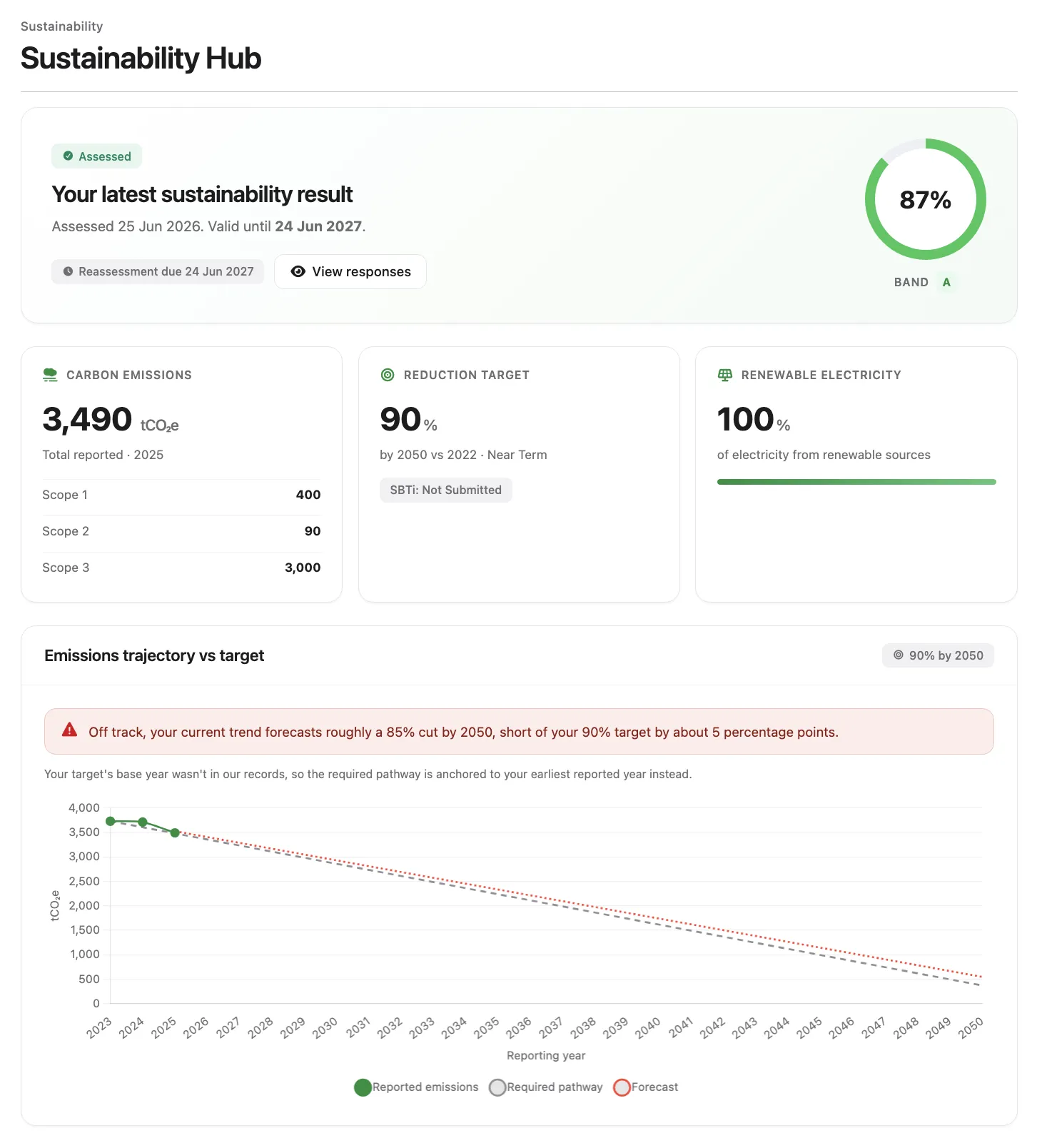
Sustainability is becoming an increasingly important part of doing business in construction. Whether you're responding to a pre-qualification questionnaire (PQQ), working towards Net Zero or strengthening your environmental credentials, clients are increasingly asking suppliers to demonstrate their sustainability performance. The Mobilize Sustainability Assessment has been designed to make that process simple. Rather than completing different sustainability questionnaires for multiple clients, suppliers complete a single structured assessment that measures their sustainability performance, records supporting evidence and provides instant feedback on where they are performing well and where improvements can be made. The same assessment can then be viewed by participating supply chain owners, reducing duplicated effort. In this guide, we'll explain how to register, complete your assessment and make the most of the information it provides.

Choosing Supply Chain Management Software: The Questions to Ask Before You Buy
Choosing the right supply chain management software is about more than digitising PQQs or storing supplier documents. For main contractors, the real value comes from knowing which subcontractors meet your requirements, keeping that information current and making better procurement decisions. This practical buyer's guide explores the questions every construction business should ask before investing in a new platform.