


Summary
As sustainability becomes a greater priority across the construction industry, organisations are investing more time and resources into measuring their carbon emissions. From Carbon Reduction Plans to Scope 1, Scope 2 and Scope 3 reporting, businesses are gathering more environmental data than ever before. But there is one question that often gets overlooked: Can you trust the data you're reporting? After all, even the most ambitious sustainability strategy is only as good as the information it's built on. If your carbon data is incomplete, inconsistent or out of date, the decisions you make and the reports you produce may not reflect the true environmental impact of your business.
Good Decisions Start With Good Data
Every sustainability decision relies on data.
Whether you're identifying your largest sources of emissions, setting reduction targets or reporting progress to clients, you're making decisions based on the information available to you.
If that information is inaccurate, the consequences can be significant.
Poor quality data can lead to:
- Incorrect carbon calculations
- Misleading reports
- Unrealistic reduction targets
- Missed opportunities for improvement
- Reduced confidence from clients and stakeholders
The better your data, the more confidence you can have in your sustainability strategy.
The Biggest Challenge Is Often the Supply Chain
For many construction businesses, the majority of emissions sit outside their own organisation.
Materials, subcontractors, transport and supplier operations all contribute to a project's overall carbon footprint.
That means much of the information needed to measure environmental performance comes from your supply chain.
Unfortunately, supplier data is often:
- Stored across multiple spreadsheets
- Collected through email
- Missing key information
- Recorded in different formats
- Updated at different times
This makes it difficult to build an accurate picture of your overall emissions.
Inconsistent Data Creates Inconsistent Reporting
Imagine asking ten suppliers to provide their carbon information.
Some may submit detailed Carbon Reduction Plans.
Others might provide a sustainability policy.
Some may report Scope 1 and Scope 2 emissions, while others include Scope 3.
A few may provide no information at all.
Without a consistent process for collecting and managing environmental data, comparing suppliers becomes extremely difficult.
Standardised information leads to more reliable reporting and better decision making.
Sustainability Is More Than a Spreadsheet
Spreadsheets remain one of the most common ways to manage sustainability information.
Whilst they have their place, they become increasingly difficult to manage as organisations grow.
Common challenges include:
- Multiple versions of the same file
- Manual data entry
- Formula errors
- Missing documents
- Outdated information
- Limited visibility across teams
These issues don't just create administrative work, they increase the risk of reporting inaccurate information.
Carbon Reporting Is Becoming a Business Requirement
Environmental reporting is no longer limited to sustainability teams.
Today, procurement teams, clients and investors increasingly want evidence that organisations understand and manage their environmental impact.
Businesses are commonly being asked to provide:
- Carbon Reduction Plans
- Scope 1, 2 and 3 emissions
- Environmental policies
- Sustainability commitments
- Carbon reduction initiatives
- Evidence of continual improvement
The quality of the underlying data is becoming just as important as the report itself.
Better Data Leads to Better Outcomes
Reliable carbon data helps organisations to:
- Identify their biggest sources of emissions
- Prioritise improvement initiatives
- Measure progress over time
- Produce more accurate reports
- Respond confidently to client enquiries
- Support procurement submissions
Rather than simply collecting data for compliance, organisations can use it to make better informed business decisions.
Building a Single Source of Truth
One of the biggest steps organisations can take is to centralise sustainability information.
Instead of storing environmental data across emails, spreadsheets and individual documents, bringing everything together into one place improves:
- Accuracy
- Consistency
- Visibility
- Collaboration
- Reporting
- Audit readiness
When everyone is working from the same information, reporting becomes simpler and more reliable.
How Mobilize Supports Better Sustainability Data
Collecting sustainability information across dozens, or even hundreds of suppliers can quickly become difficult.
Mobilize helps organisations manage supplier sustainability information in a structured and consistent way by centralising:
- Sustainability assessments
- Carbon Reduction Plans
- Environmental policies
- Supplier questionnaires
- Compliance documents
- Certifications
- Supporting evidence
This gives procurement and sustainability teams greater visibility across their supply chain, helping ensure environmental information remains accurate, up to date and easy to access when it's needed.
Looking Ahead
As environmental reporting continues to evolve, organisations will be expected to demonstrate not only that they are reducing emissions, but also that the data behind those claims is accurate and reliable.
Clients, regulators and supply chain partners are placing increasing importance on transparency.
Businesses that invest in strong data management today will be better prepared to meet tomorrow's sustainability expectations.
Conclusion
Carbon reporting is about more than numbers.
It's about having confidence that those numbers tell the right story.
Without reliable data, even the best sustainability strategy can be built on uncertain foundations.
By improving the way environmental information is collected, managed and shared across the supply chain, organisations can produce more meaningful reports, make better decisions and take more effective action towards reducing emissions.
Because achieving Net Zero doesn't just start with measuring carbon.
It starts with being able to trust the information behind it.

Posted on 22 Jul 2026
Related platformMobilize
Supply Chain Management
You’re chasing suppliers for certificates that expired last month. Mobilize onboards them once, then keeps insurance, accreditations and PQQ answers current automatically, so you know who is approved before you tender.
Find out more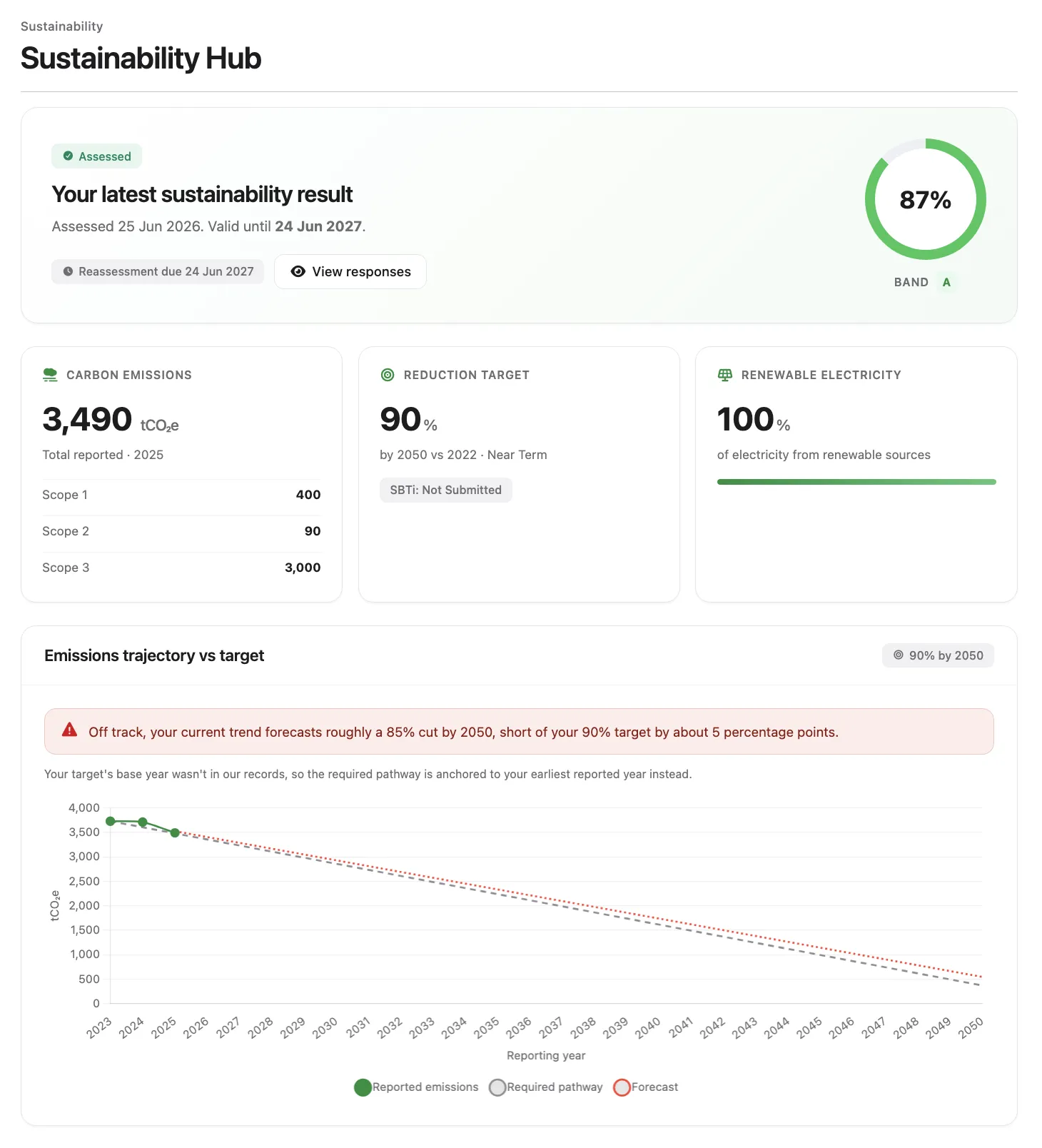
How to Complete the Mobilize Sustainability Assessment
Sustainability is becoming an increasingly important part of doing business in construction. Whether you're responding to a pre-qualification questionnaire (PQQ), working towards Net Zero or strengthening your environmental credentials, clients are increasingly asking suppliers to demonstrate their sustainability performance. The Mobilize Sustainability Assessment has been designed to make that process simple. Rather than completing different sustainability questionnaires for multiple clients, suppliers complete a single structured assessment that measures their sustainability performance, records supporting evidence and provides instant feedback on where they are performing well and where improvements can be made. The same assessment can then be viewed by participating supply chain owners, reducing duplicated effort. In this guide, we'll explain how to register, complete your assessment and make the most of the information it provides.

Why Recording Scope 1, Scope 2 and Scope 3 Emissions Is Becoming Essential in Construction
Sustainability is no longer a "nice to have" in construction. Clients, investors, regulators and supply chain partners are increasingly expecting organisations to understand and reduce their environmental impact. For many businesses, this starts with measuring carbon emissions. However, carbon reporting is often more complex than simply looking at fuel usage or electricity bills. To build a complete picture, organisations need to understand Scope 1, Scope 2 and Scope 3 emissions. Whilst these terms are becoming increasingly common in tenders and sustainability reports, many organisations are still unsure what they actually mean, or why they matter. Understanding the differences is the first step towards making better decisions, improving reporting and building a more sustainable construction industry.
Why Most Net Zero Strategies Fail Before They Reach the Supply Chain
Over the past few years, net zero has moved from a sustainability initiative to a boardroom priority. Businesses are measuring carbon emissions, publishing carbon reduction plans and setting ambitious net zero targets. Yet many organisations still struggle to achieve meaningful progress. The reason is surprisingly simple. Most net zero strategies focus heavily on internal operations while overlooking the area that often contributes the largest share of emissions: the supply chain. For many organisations, particularly in construction, facilities management and infrastructure, supplier-related emissions can account for the majority of their overall carbon footprint. Until businesses gain visibility of their supply chains, meaningful carbon reduction will remain difficult to achieve.