


Summary
Artificial Intelligence (AI) has become one of the most talked-about technologies in business today. From automating repetitive tasks to providing instant insights, AI promises to transform the way organisations manage their supply chains. However, whilst many businesses are focusing on implementing AI, far fewer are focusing on something even more important: data quality. The reality is that AI is only as good as the information it can access. If supplier records are incomplete, compliance data is inaccurate, or documentation is stored across multiple disconnected systems, AI cannot magically fix these problems. In fact, poor data often leads to poor decisions, just made faster. Before organisations invest heavily in AI, they should first ensure they have accurate, structured and trustworthy data. Because in construction supply chain management, good data often matters more than AI itself.
The AI Hype Cycle
AI is everywhere.
Every day, organisations are being told that AI can:
- Improve productivity
- Automate decision-making
- Reduce administration
- Enhance reporting
- Identify risks automatically
- Improve compliance management
While many of these benefits are achievable, there is often one crucial detail missing from the conversation:
AI requires reliable data to be effective.
Many organisations are rushing to introduce AI tools without first assessing the quality of the information those tools will rely on.
AI Doesn't Solve Data Problems
One of the biggest misconceptions surrounding AI is that it can somehow compensate for poor data.
It cannot, Ai can:
- analyse information faster than humans.
- identify patterns.
- summarise large datasets.
- provide recommendations.
But it cannot reliably determine which information is correct when the underlying data is inaccurate.
If your supplier records contain errors, duplicates or missing information, AI will simply work with that flawed data.
The result is often described by a phrase that has existed long before AI:
Garbage In, Garbage Out.
What Poor Data Looks Like in Construction Supply Chains
Construction supply chains generate significant volumes of information.
Examples include:
- Supplier details
- Insurance certificates
- Accreditations
- Financial records
- Risk assessments
- Performance data
- Audit records
- Compliance documentation
Unfortunately, much of this information is often:
- Stored across multiple systems
- Maintained inconsistently
- Out of date
- Duplicated
- Missing altogether
These issues may seem minor individually, but collectively they create significant challenges.
A Real-World Example
Imagine asking an AI assistant:
"Is Supplier ABC compliant?"
The AI checks the available information and responds:
"Yes, Supplier ABC is compliant."
However:
- Their insurance expired three months ago
- Their ISO certificate has not been renewed
- Their supplier record exists twice within the system
- Recent audit findings have not been uploaded
The AI has not necessarily made a mistake.
It has simply provided an answer based on the information available to it.
The real problem was the underlying data.
This is why organisations should focus on improving data quality before placing significant reliance on AI-generated insights.
Why Data Quality Matters More Than Ever
Poor data creates problems regardless of whether AI is involved.
However, AI has the potential to amplify these issues.
When decision-makers trust AI outputs without understanding the quality of the underlying information, organisations may experience:
- Incorrect compliance decisions
- Supplier approval errors
- Inaccurate risk assessments
- Poor procurement decisions
- Increased audit risk
- Reputational damage
AI can accelerate decision-making, but only if the information driving those decisions can be trusted.
Construction Supply Chains Are Particularly Complex
Construction supply chains are rarely simple.
Many organisations manage:
- Hundreds or thousands of suppliers
- Multiple compliance requirements
- Various certification types
- Ongoing audits and assessments
- Expiring documents
- Complex approval workflows
The volume of information involved means that even small data quality issues can have a significant impact.
As supply chains grow, maintaining accurate supplier information becomes increasingly important.
Building an AI-Ready Supply Chain
Before introducing AI into supply chain processes, organisations should focus on building strong data foundations.
This includes:
Centralising Information
Information should not be spread across:
- Emails
- Shared drives
- Spreadsheets
- Multiple systems
A centralised source of truth improves consistency and accessibility.
Standardising Processes
Supplier onboarding, compliance reviews and assessments should follow consistent processes. This reduces variation and improves data quality.
Improving Data Governance
Clear ownership should exist for:
- Supplier records
- Compliance data
- Performance information
- Risk assessments
Good governance ensures information remains accurate over time.
Eliminating Duplicate Records
Duplicate suppliers create confusion and undermine reporting accuracy. Maintaining a single supplier record improves visibility and confidence in the data.
Regular Data Reviews
Supplier information should be reviewed and updated regularly to ensure it remains current.
The Cost of Poor Data
Whilst organisations often focus on the cost of AI implementation, the cost of poor data is often far greater.
Poor data can result in:
- Increased administration
- Delayed supplier approvals
- Compliance failures
- Audit findings
- Contractual disputes
- Poor operational decisions
In many cases, organisations spend more time correcting data issues than they do analysing information.
Improving data quality often delivers immediate operational benefits, whether AI is used or not.
AI Works Best When Built on Trusted Data
This does not mean organisations should avoid AI.
Far from it.
AI has enormous potential to improve supply chain management.
However, AI should be viewed as a layer that sits on top of trusted information, not as a replacement for good data management.
The organisations achieving the greatest value from AI are typically those that already have:
- Strong governance
- Structured processes
- Reliable data
- Clear ownership
AI amplifies good data just as effectively as it amplifies bad data.
How Mobilize Supports Better Data Quality
At Liaison Systems, we believe successful AI starts with trusted information.
That is why Mobilize focuses on creating a structured and governed environment for supplier and compliance data.
Mobilize helps organisations:
- Centralise supplier information
- Standardise onboarding processes
- Manage compliance documentation
- Track supplier performance
- Maintain audit trails
- Improve visibility across the supply chain
By creating a single source of truth, organisations gain greater confidence in their supplier data and are better positioned to benefit from AI-driven insights in the future.
Rather than relying on AI to solve data problems, Mobilize helps organisations build the strong foundations required for AI to deliver meaningful value.
The Trusted Data Advantage White Paper
AI promises faster supplier decisions, less admin and automatic risk detection. But it can't fix supplier records that are duplicated, certificates that have quietly expired or compliance evidence collected once and never checked again. Our free white paper, The Trusted Data Advantage, shows how to build a supply chain that's governed, auditable and genuinely ready for AI, covering supplier onboarding, risk scoring, compliance, sustainability and the Golden Thread.
Conclusion
AI may be transforming the way organisations manage construction supply chains, but technology alone is not enough.
Without accurate, reliable and well-governed data, even the most advanced AI solutions will struggle to deliver meaningful results.
Before asking:
"How can we use AI?"
Organisations should first ask:
"Can we trust our data?"
Because in construction supply chain management, good data is not just important, it is the foundation upon which every successful AI strategy is built.

Posted on 15 Jun 2026
Related platformMobilize
Supply Chain Management
Mobilize offers a fully customisable suite of tools designed to help you manage your entire supply chain with precision giving you complete visibility and control so that you can reduced risk at every stage, from onboarding through to project review.
Find out more
AI in Construction Supply Chain Management: Smarter Decisions, Not Blind Automation
Artificial intelligence is rapidly becoming part of everyday business operations and construction supply chain management is no exception. From automating repetitive tasks to surfacing operational insights, AI has the potential to significantly improve efficiency and decision-making. However, while AI is powerful, it is not infallible. AI models can hallucinate, misunderstand context or present inaccurate information with confidence. In high-risk, compliance-driven environments such as construction supply chains, blindly relying on AI creates unnecessary risk. The real opportunity lies in using AI in a controlled and governed way, accelerating processes, improving visibility and supporting better human decision-making without replacing oversight.

The Building Safety Levy: What It Means for Your Supply Chain Costs
From 1st October 2026, the Building Safety Levy will introduce a new cost for many residential developments in England, with funds contributing towards the remediation of historic building safety defects. While the levy is payable by developers rather than suppliers, additional development costs inevitably raise questions about budgets, procurement and supply-chain pressure. We look at what is changing, who the levy affects and why strong supply-chain management will become even more important.
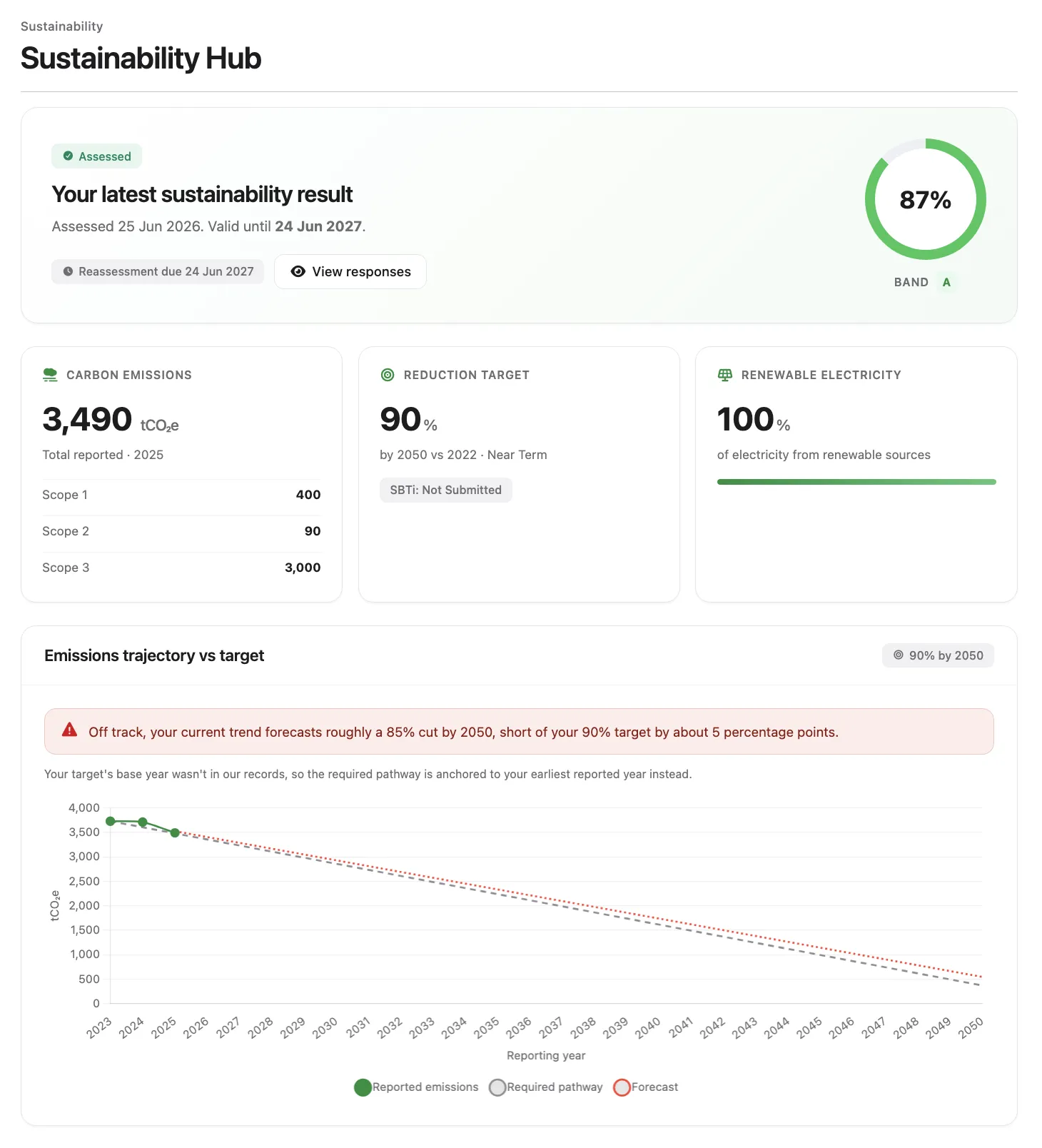
How to Complete the Mobilize Sustainability Assessment
Sustainability is becoming an increasingly important part of doing business in construction. Whether you're responding to a pre-qualification questionnaire (PQQ), working towards Net Zero or strengthening your environmental credentials, clients are increasingly asking suppliers to demonstrate their sustainability performance. The Mobilize Sustainability Assessment has been designed to make that process simple. Rather than completing different sustainability questionnaires for multiple clients, suppliers complete a single structured assessment that measures their sustainability performance, records supporting evidence and provides instant feedback on where they are performing well and where improvements can be made. The same assessment can then be viewed by participating supply chain owners, reducing duplicated effort. In this guide, we'll explain how to register, complete your assessment and make the most of the information it provides.