


Summary
PAS 91 and the Common Assessment Standard are both widely used pre-qualification frameworks within the UK construction industry. While PAS 91 was historically the standardised pre-qualification questionnaire used during the procurement process, it has now largely been replaced by the Common Assessment Standard. Understanding the difference between the two is essential for contractors, buyers and suppliers navigating compliance, risk management and industry accreditation requirements.
What Is PAS 91?
PAS 91 was a standardised pre-qualification questionnaire (PQQ) developed to streamline supplier selection in the UK construction industry.
It was designed to:
- Reduce duplication across procurement processes.
- Standardise compliance questions.
- Support fair and transparent contractor selection.
The PAS 91 questionnaire covered areas such as:
- Health and safety
- Financial standing
- Environmental management
- Equal opportunities
- Insurance
- Quality management
For many years, PAS 91 formed the backbone of pre-qualification across public and private sector construction projects.
Why Was PAS 91 Introduced?
Before PAS 91, contractors were required to complete different questionnaires for every buyer. This created unnecessary duplication and administrative burden.
PAS 91 aimed to:
- Save time and money
- Reduce repetitive submissions
- Create a consistent compliance structure
- Improve risk management across the construction industry
However, as compliance expectations evolved particularly following regulatory reforms such as the Building Safety Act the need for a more comprehensive standard became clear.
What Is the Common Assessment Standard (CAS)?
The Common Assessment Standard (CAS) is the successor to PAS 91.
Developed by Build UK and industry partners, it builds upon PAS 91 by expanding the scope of required information and strengthening compliance expectations.
The Common Assessment Standard includes:
- Core PAS 91 requirements
- Enhanced risk management criteria
- Building Safety Act alignment
- Corporate and personal liability considerations
- Environmental, social and governance (ESG) requirements
- Modern slavery compliance
- Cyber security considerations
Unlike PAS 91, which focused primarily on standardisation, the Common Assessment Standard reflects broader regulatory and reputational risks within construction projects.
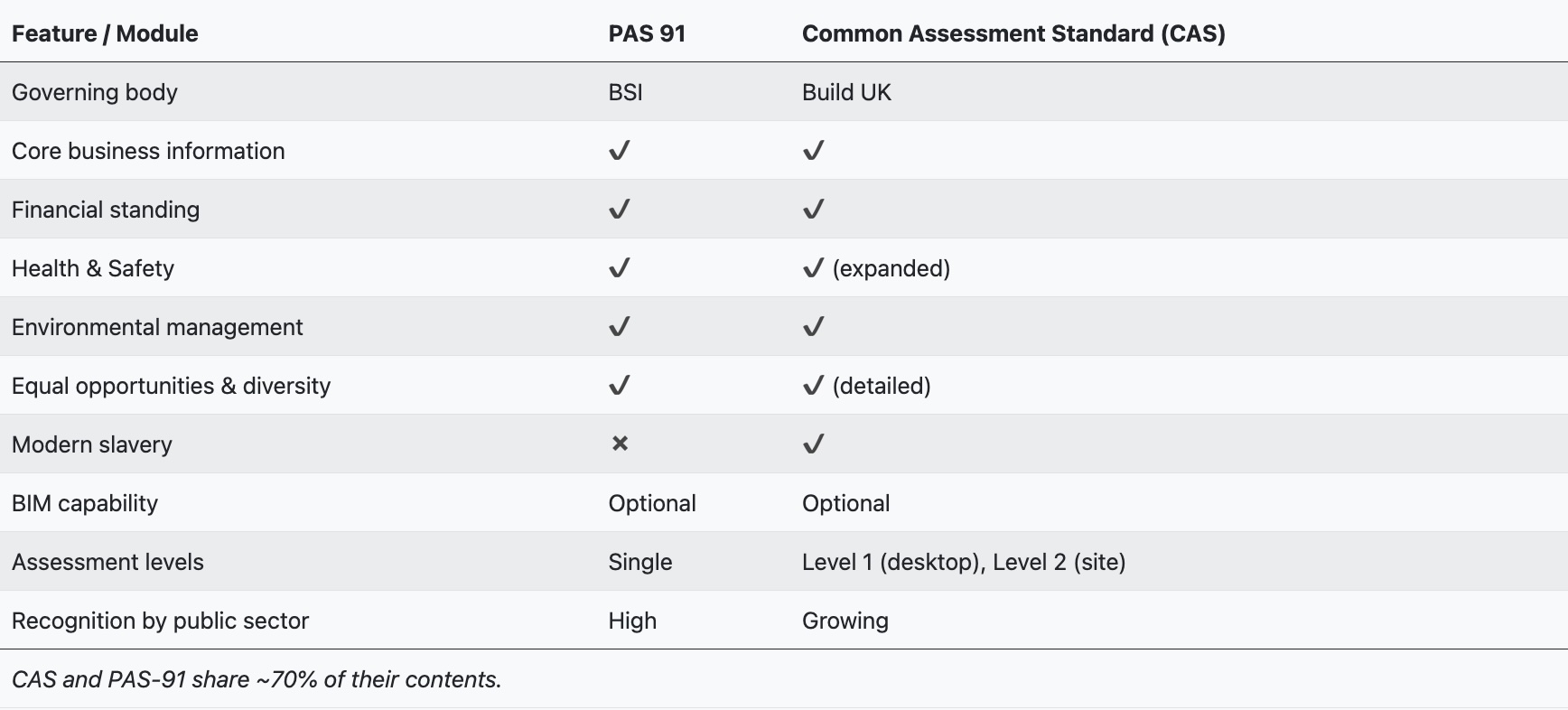
Side‑by‑Side Comparison
The Common Assessment Standard does not simply replace PAS 91, it strengthens it.
Which Standard Should You Use?

Is PAS 91 Still Used?
This transition was reinforced by the UK Government’s Procurement Policy Note (PPN 03/24), which formally supports the use of the Common Assessment Standard in public sector construction procurement. As a result, most public sector buyers now expect suppliers to demonstrate compliance with the Common Assessment Standard rather than PAS 91.
However, some buyers and procurement teams may still reference PAS 91 terminology. In practice, most recognised assessment providers now align with the Common Assessment Standard.
Contractors who previously held PAS 91 accreditation have typically transitioned to CAS compliance.
Why the Change Matters for Contractors
The shift from PAS 91 to the Common Assessment Standard reflects a broader change in industry expectations.
Today’s procurement process prioritises:
- Demonstrable risk management
- Building safety compliance
- Supply chain transparency
- Financial stability
- Ongoing regulatory alignment
For buyers and suppliers, compliance is no longer just about ticking boxes, it is about evidencing capability and governance.
How Does the Common Assessment Standard Improve Risk Management?
The updated framework strengthens risk management by requiring:
- Clear safety leadership structures
- Defined compliance responsibilities
- Evidence of policy implementation
- Documented procedures
- Accountability across the supply chain
In the context of the Building Safety Act, this enhanced scrutiny helps ensure qualified contractors are involved in the project from the outset.
What Should Contractors Do Now?
If your organisation previously completed a PAS 91 questionnaire UK submission, you should:
- Confirm your accreditation aligns with the Common Assessment Standard
- Review policies for Building Safety Act compliance
- Ensure documentation is regularly updated
- Monitor changes in procurement expectations
Early preparation prevents delays during tender submissions.
Transitioning From PAS 91 to CAS: 4‑Step Plan
- Gap analysis – Identify CAS questions not covered by your current PAS 91 form.
- Supplier comms – Notify suppliers of the upcoming change and provide guidance.
- Dual period – Accept both standards during a defined transition window.
- Fully adopt CAS – Once ≥80% of suppliers meet CAS, switch primary requirement.
CAS Checklist
Our free CAS checklist provides a structured framework to help you build your PQQ in line with the Common Assessment Standard (CAS). Each section in the contents links directly to a corresponding tab, making it easy to navigate and use.
The Future of Pre-Qualification in Construction
Pre-qualification standards will continue evolving as regulatory and industry expectations grow.
We are likely to see:
- Increased digital verification
- Stronger ESG measurement
- Greater focus on competence and safety
- Ongoing reform linked to building safety legislation
The Common Assessment Standard represents a step toward more robust and transparent contractor assessment.
Final Thoughts
PAS-91 played an important role in standardising pre-qualification across the construction industry. However, the Common Assessment Standard now sets the benchmark.
For contractors, buyers and suppliers, understanding this shift is essential to maintaining compliance, protecting reputation and succeeding in today’s procurement landscape.
If you need support managing compliance documentation or navigating evolving assessment standards, our team can help streamline and structure the process efficiently.

Posted on 25 Aug 2025
Related platformMobilize
Supply Chain Management
Mobilize offers a fully customisable suite of tools designed to help you manage your entire supply chain with precision giving you complete visibility and control so that you can reduced risk at every stage, from onboarding through to project review.
Find out more
Common Assessment Standard vs SSIP: What's the Difference?
The Common Assessment Standard (CAS) and SSIP (Safety Schemes in Procurement) are often confused, but they cover very different ground. SSIP deals only with health and safety competence and provides mutual recognition between H&S assessment schemes. CAS is far broader - a full pre-qualification framework covering 10 areas, of which health and safety is just one. CHAS and Constructionline are not standards at all; they are assessment bodies that can certify you against both SSIP and CAS. This guide explains how they relate, where they overlap, and which your business actually needs.

The Common Assessment Standard Checklist: All 10 Sections Explained
The Common Assessment Standard (CAS) question set is divided into 10 sections, each covering a different area of compliance and risk management. To pass your audit, you need the right evidence ready for each one - not just a yes/no answer. This checklist explains all 10 CAS sections, what each looks for, and the documents you should have to hand before you start. Use it to gap-check your own readiness, then download our free CAS checklist to track your progress section by section.

How to Get Common Assessment Standard Certified: A Step-by-Step Guide for Suppliers
To get Common Assessment Standard (CAS) certified, you apply to one of the seven Build UK Recognised Assessment Bodies - such as Constructionline, CHAS or Compliance Chain - complete the industry-agreed question set, submit supporting evidence and pass either a desktop or site-based audit. Certification lasts one year. Because of CAS data sharing, you only need to be certified once and can then share the result with other bodies and clients. This guide walks through the process step by step, explains the two audit levels, and shows how to prepare so you pass first time.