


Summary
Scope 3 emissions can represent a significant part of a construction organisation's carbon footprint, but measuring them relies heavily on information from the wider supply chain. Some suppliers will already have detailed emissions data, while others may only be starting their sustainability journey. So, how do you collect consistent, useful information across hundreds of different suppliers? We look at how construction businesses can make Scope 3 data collection more manageable.
"Can You Send Us Your Emissions Data?"
It sounds like a simple question.
Ask it across a construction supply chain of 100, 300, or 500 suppliers, and things quickly become more complicated.
Some suppliers will have detailed carbon reports.
Some will have started measuring their Scope 1 and Scope 2 emissions, but know very little about Scope 3.
Others may simply reply: "We don't know."
And that's where the real challenge of Scope 3 begins.
For construction businesses looking to understand their carbon footprint, collecting information from the supply chain can be one of the most difficult parts of the process.
The solution isn't to expect every supplier to become a carbon reporting expert overnight.
It's about understanding where your supply chain is today, collecting information consistently and improving the quality of that information over time.
Why Is Scope 3 Data So Difficult to Collect?
Scope 1 emissions come from sources an organisation owns or controls.
Scope 2 covers indirect emissions associated with purchased electricity, heat, or steam.
Scope 3 is different.
It covers indirect emissions occurring throughout the wider value chain.
For construction organisations, this can involve materials, products, transportation, subcontractors, waste, business travel, and numerous other activities.
The GHG Protocol identifies 15 categories of Scope 3 emissions across upstream and downstream activities.
That means much of the information required to understand Scope 3 sits outside your own organisation.
You have to rely on other businesses to provide it.
And every supplier may be at a different stage of their sustainability journey.
Start by Understanding What You Actually Need
One of the easiest ways to make Scope 3 data collection unnecessarily difficult is to ask suppliers for everything.
Before sending another questionnaire, consider what information will actually be useful.
Depending on your objectives, you may want to understand areas such as:
- Whether the supplier currently measures carbon emissions
- Their Scope 1 emissions
- Their Scope 2 emissions
- Whether they measure any Scope 3 categories
- Their reporting period
- Whether they have established a carbon baseline
- Whether they have carbon reduction targets
- What actions they are taking to reduce emissions
- Whether supporting evidence is available
- The methodology used to calculate their emissions
The information you request should have a purpose.
Collecting sustainability data simply because it might be useful one day creates additional work for your team and your suppliers.
Don't Expect Perfect Data on Day One
This is perhaps one of the most important points.
Your first Scope 3 exercise probably won't produce perfect data.
And that's OK.
The GHG Protocol acknowledges that organisations may initially need to use lower quality data where better information isn't available, with data quality improving over time.
For construction businesses, this is particularly important.
A large contractor might work with hundreds of suppliers ranging from major manufacturers and specialist subcontractors to small local businesses.
Their ability to calculate emissions will vary enormously.
One supplier may provide independently verified emissions figures.
Another may have only recently started recording fuel and electricity consumption.
Treating those businesses as though they should already be at the same level can create unnecessary barriers.
The first step is understanding where everyone is starting from.
Create a Consistent Assessment
If every supplier is asked different questions in different formats, comparing information becomes extremely difficult.
A consistent sustainability assessment can help establish a common starting point.
Ask the same core questions.
Use consistent terminology.
Explain what information is required.
Provide guidance where suppliers may not understand a question.
Allow evidence to be provided where appropriate.
Consistency makes it easier to understand where gaps exist across the supply chain, and how sustainability performance changes over time.
It also makes the process clearer for suppliers.
Make It Easy for Suppliers to Respond
Supplier engagement is critical.
If your sustainability assessment is confusing, overly complicated, or takes hours to complete, response rates are unlikely to improve.
Think about the process from the supplier's perspective.
Do they understand why you're requesting the information?
Do they know what Scope 1, Scope 2, and Scope 3 mean?
Can they save their progress?
Can they provide information they already have?
Is guidance available when they need it?
Can they upload supporting evidence?
Good data collection isn't simply about asking the right questions.
It's about making those questions easy to answer.
What If a Supplier Doesn't Know Their Emissions?
This is where the process can become genuinely useful.
A supplier answering "we don't currently measure this" isn't necessarily a failure.
It's information.
You now know where that supplier is on their sustainability journey.
Instead of excluding them from the conversation, this can become an opportunity to encourage improvement.
Perhaps the first step is recording fuel consumption.
Then electricity.
Then establishing a baseline.
Then setting a reduction target.
Then reviewing progress.
Over time, the quality of the information improves.
The first step to better Scope 3 data is understanding what your supply chain knows today.
Prioritise Where Better Data Matters Most
You don't necessarily need the same level of detail from every supplier immediately.
The GHG Protocol recommends prioritising data collection based on factors such as the expected size of emissions, the importance of the supplier, and the ability to influence them.
For a construction business, that could mean initially focusing on major spend categories, carbon intensive materials, strategically important suppliers, or areas where emissions are expected to be highest.
Once those areas are better understood, data collection can gradually become more detailed across the wider supply chain.
This makes the process much more manageable than trying to achieve perfect coverage immediately.
Ask for Evidence, Not Just Numbers
A carbon figure without any context can be difficult to interpret.
Where appropriate, ask suppliers to explain how their emissions were calculated.
Useful supporting information might include:
- Reporting period
- Organisational boundaries
- Calculation methodology
- Emission factors used
- Supporting consumption information
- Carbon reports
- Independent verification or assurance
Not every supplier will have all of this information.
But understanding where a number came from helps you assess how much confidence to place in it.
It also helps improve consistency as your reporting process matures.
Avoid the Spreadsheet Trap
At first, collecting supplier sustainability information through spreadsheets can seem manageable.
Ten suppliers?
Probably.
Fifty suppliers?
Perhaps.
Five hundred suppliers?
Things become considerably more difficult.
Different spreadsheet versions are emailed backwards and forwards.
Suppliers miss questions.
Evidence arrives separately.
Someone has to chase responses.
Someone else has to combine the results.
Then, twelve months later, the process starts again.
The challenge isn't simply collecting Scope 3 information once.
It's maintaining it.
Make Sustainability Part of Supplier Management
One of the most effective ways to improve Scope 3 data collection is to stop treating sustainability as a completely separate exercise.
Supplier sustainability information can form part of the wider supplier relationship.
When a supplier joins your supply chain, understand their sustainability position.
When their information changes, update it.
When an assessment is renewed, review their progress.
When procurement decisions are made, consider relevant sustainability information alongside other factors.
This moves sustainability away from being an annual questionnaire, and towards becoming part of everyday supply chain management.
Use the Data to Start Conversations
Collecting emissions information shouldn't simply result in another dashboard.
The real value comes from what happens next.
Which areas of your supply chain are responsible for the greatest emissions?
Which suppliers are already making strong progress?
Where are the biggest data gaps?
Which suppliers need additional guidance?
Where could collaboration achieve meaningful reductions?
Scope 3 isn't something most businesses can solve independently.
By definition, it requires organisations across the value chain to work together.
Track Improvement Over Time
Your first year of Scope 3 reporting establishes a starting point.
The following year should improve on it.
Perhaps more suppliers provide emissions figures.
Perhaps more data becomes supplier specific.
Perhaps suppliers that previously had no carbon reduction plan now have targets in place.
Perhaps evidence quality improves.
Tracking this progression is important because Scope 3 reporting shouldn't only be about producing a number.
It should help demonstrate whether the supply chain is actually moving in the right direction.
How Mobilize Can Help
Liaison's Mobilize Sustainability assessment helps organisations gather consistent sustainability information from their supply chain.
Suppliers can complete an assessment covering areas including Scope 1, Scope 2, and Scope 3 emissions, carbon reduction targets, progress, and supporting evidence.
This gives supply chain owners greater visibility of where individual suppliers are on their sustainability journey, while providing a consistent structure for gathering information across the wider supply chain.
Rather than relying on disconnected spreadsheets, emails, and one off requests, sustainability information can form part of the supplier management process.
For suppliers, the assessment also provides guidance throughout the process, helping businesses that may be taking their first steps towards understanding and recording their emissions.
Start With Progress, Not Perfection
Scope 3 data collection can feel overwhelming.
There may be hundreds of suppliers.
Different levels of sustainability knowledge.
Different calculation methods.
Missing information.
And plenty of "we don't know yet" responses.
But none of that means you shouldn't start.
The objective isn't to create a perfect dataset overnight.
It's to establish a consistent process that becomes stronger over time.
Start with the information available.
Identify the gaps.
Engage your suppliers.
Improve data quality.
And keep going.
Conclusion
Understanding Scope 3 emissions requires businesses to look beyond their own operations and into the wider supply chain.
That makes supplier engagement essential.
But getting useful emissions information doesn't have to mean demanding perfect carbon reports from every supplier from day one.
Start by asking consistent questions.
Understand what suppliers already know.
Provide guidance where they need it.
Prioritise the areas that matter most.
And improve the quality of your information over time.
Because better Scope 3 reporting doesn't begin with perfect data.
It begins with starting the conversation.

Posted on 23 Sep 2026
Related platformMobilize
Supply Chain Management
You’re chasing suppliers for certificates that expired last month. Mobilize onboards them once, then keeps insurance, accreditations and PQQ answers current automatically, so you know who is approved before you tender.
Find out more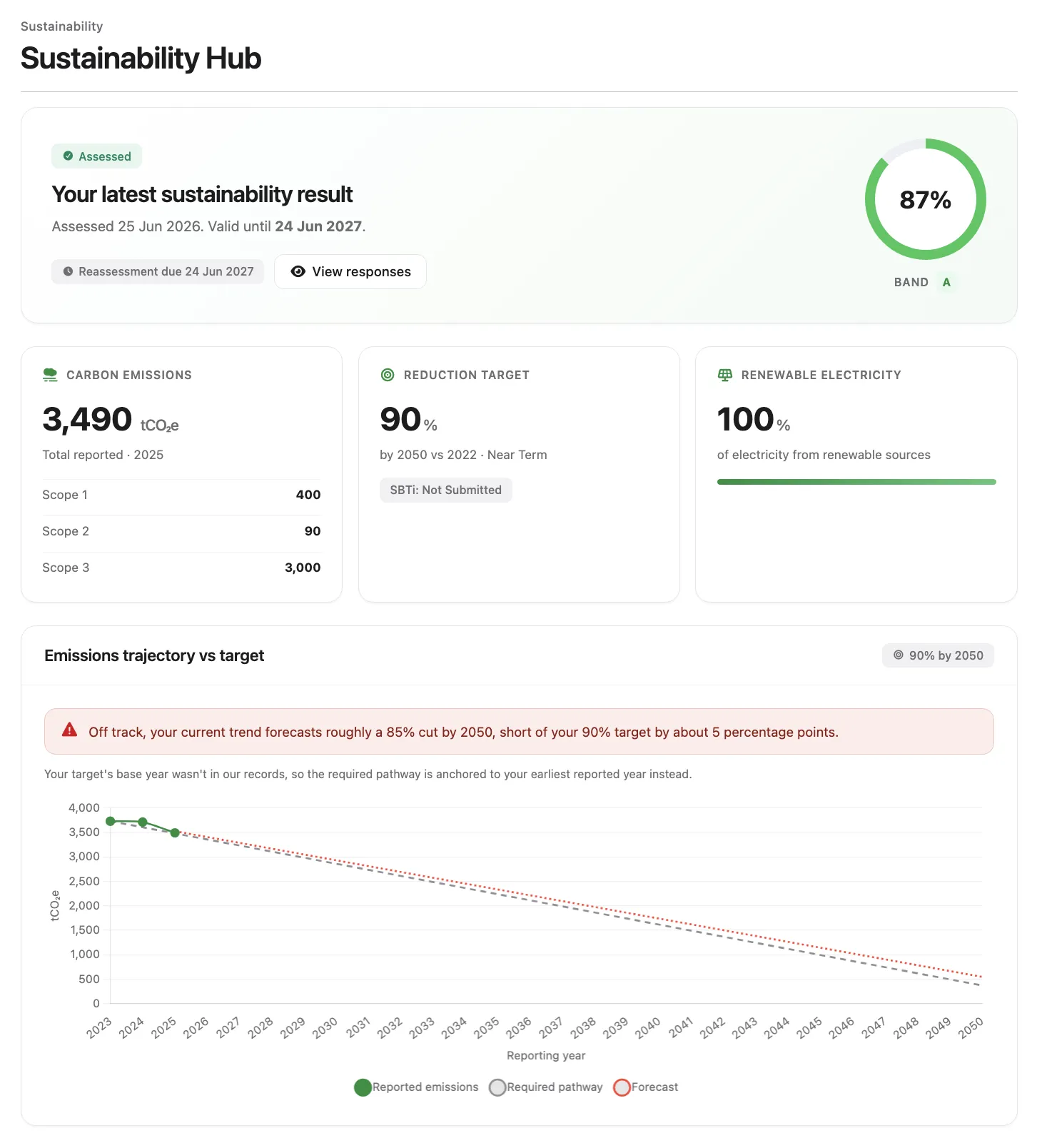
How to Complete the Mobilize Sustainability Assessment
Sustainability is becoming an increasingly important part of doing business in construction. Whether you're responding to a pre-qualification questionnaire (PQQ), working towards Net Zero or strengthening your environmental credentials, clients are increasingly asking suppliers to demonstrate their sustainability performance. The Mobilize Sustainability Assessment has been designed to make that process simple. Rather than completing different sustainability questionnaires for multiple clients, suppliers complete a single structured assessment that measures their sustainability performance, records supporting evidence and provides instant feedback on where they are performing well and where improvements can be made. The same assessment can then be viewed by participating supply chain owners, reducing duplicated effort. In this guide, we'll explain how to register, complete your assessment and make the most of the information it provides.

Why Carbon Data Is Only as Good as the Information Behind It
As sustainability becomes a greater priority across the construction industry, organisations are investing more time and resources into measuring their carbon emissions. From Carbon Reduction Plans to Scope 1, Scope 2 and Scope 3 reporting, businesses are gathering more environmental data than ever before. But there is one question that often gets overlooked: Can you trust the data you're reporting? After all, even the most ambitious sustainability strategy is only as good as the information it's built on. If your carbon data is incomplete, inconsistent or out of date, the decisions you make and the reports you produce may not reflect the true environmental impact of your business.

Why Recording Scope 1, Scope 2 and Scope 3 Emissions Is Becoming Essential in Construction
Sustainability is no longer a "nice to have" in construction. Clients, investors, regulators and supply chain partners are increasingly expecting organisations to understand and reduce their environmental impact. For many businesses, this starts with measuring carbon emissions. However, carbon reporting is often more complex than simply looking at fuel usage or electricity bills. To build a complete picture, organisations need to understand Scope 1, Scope 2 and Scope 3 emissions. Whilst these terms are becoming increasingly common in tenders and sustainability reports, many organisations are still unsure what they actually mean, or why they matter. Understanding the differences is the first step towards making better decisions, improving reporting and building a more sustainable construction industry.