Insights / Supply Chain Management

Supply Chain Management

Guides and best practice on managing suppliers, compliance and risk across the supply chain.

What Makes a Good Carbon Reduction Plan?
20 Jul 2026

What Makes a Good Carbon Reduction Plan?

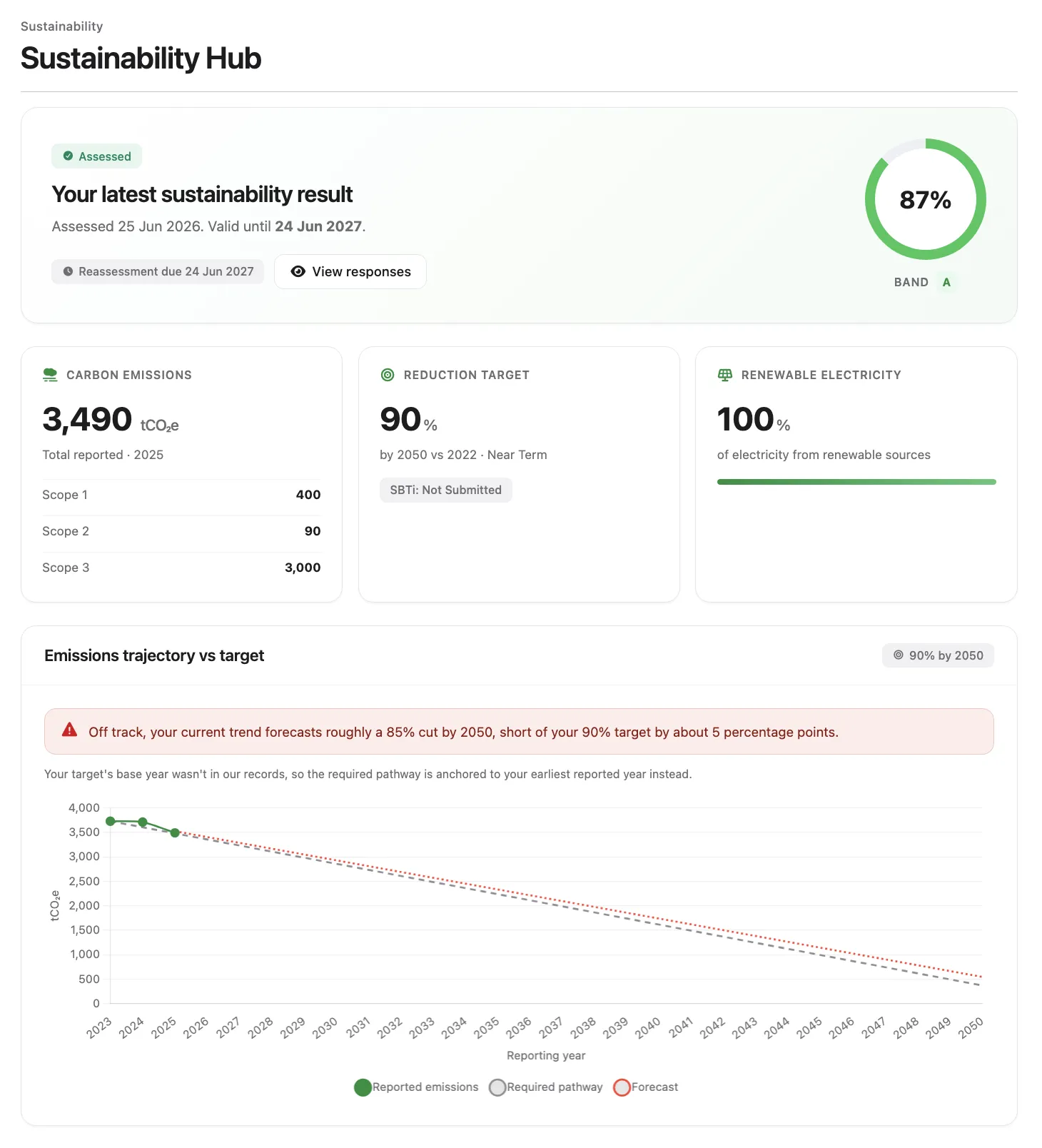
Carbon Reduction Plans (CRPs) have become an increasingly common requirement across the construction industry, particularly when bidding for public sector contracts and working with larger contractors. However, whilst many organisations now have a Carbon Reduction Plan, not all plans provide the same value. Some are little more than a compliance exercise, produced once, uploaded to a website and forgotten about. Others become a valuable business tool that helps organisations understand their emissions, engage their supply chain and make measurable progress towards their sustainability goals. So, what separates a good Carbon Reduction Plan from a poor one?

Read article
Why Recording Scope 1, Scope 2 and Scope 3 Emissions Is Becoming Essential in Construction
15 Jul 2026

Why Recording Scope 1, Scope 2 and Scope 3 Emissions Is Becoming Essential in Construction

Sustainability is no longer a "nice to have" in construction. Clients, investors, regulators and supply chain partners are increasingly expecting organisations to understand and reduce their environmental impact. For many businesses, this starts with measuring carbon emissions. However, carbon reporting is often more complex than simply looking at fuel usage or electricity bills. To build a complete picture, organisations need to understand Scope 1, Scope 2 and Scope 3 emissions. Whilst these terms are becoming increasingly common in tenders and sustainability reports, many organisations are still unsure what they actually mean, or why they matter. Understanding the differences is the first step towards making better decisions, improving reporting and building a more sustainable construction industry.

Read article
Is Your Supply Chain Data Ready for RIDDOR Changes?
06 Jul 2026

Is Your Supply Chain Data Ready for RIDDOR Changes?

The Health and Safety Executive (HSE) is consulting on reforms to the Reporting of Injuries, Diseases and Dangerous Occurrences Regulations (RIDDOR) 2013. The Civil Engineering Contractors Association (CECA) has now responded, broadly backing the direction of travel while pressing for rules that are clear, proportionate and practical for the sector. For contractors, the headline is simple: how you report incidents is about to change. What is less obvious, but more important, is that the organisations best placed to adapt will be the ones who already hold clean, accessible information on their people, their sites and their supply chains. That data groundwork has to be in place before the reforms land, not scrambled together afterwards.

Read article
The Building Safety Act 2022 Explained: A Complete Guide for Construction Professionals
01 Jul 2026

The Building Safety Act 2022 Explained: A Complete Guide for Construction Professionals

The Building Safety Act 2022 is the most significant change to building safety regulation in England in a generation. Introduced in response to the Grenfell Tower tragedy and the Hackitt Review, it creates a stricter, more accountable system for designing, constructing and managing buildings, with the strongest controls reserved for higher-risk buildings (HRBs). The Act introduces a new dutyholder regime aligned with CDM 2015, a three-stage Gateway approval process, a legal requirement for the Golden Thread of information and a comprehensive set of duties for managing buildings once they are occupied. It also established the Building Safety Regulator, which in January 2026 moved out of the Health and Safety Executive to become a standalone body, with further reform towards a single construction regulator already underway. This guide explains what the Act covers, who it affects, and the practical steps construction and supply chain teams should be taking now.

Read article
Tender Prices Could Rise Over 20% by 2029 - What It Means for Your Supply Chain
29 Jun 2026

Tender Prices Could Rise Over 20% by 2029 - What It Means for Your Supply Chain

Construction tender prices could climb by more than a fifth between now and 2029, and crucially much of that cost risk is expected to be retained by the supply chain rather than passed up the chain. That's the headline from analysis by consultancy Arcadis, reported by Construction News. With steel tariffs, geopolitical instability and a new carbon border measure all adding pressure and the cost of tendering itself rising, margins are getting squeezed from both directions. This article breaks down what the forecasts say, why suppliers are most exposed, and the practical steps, including supply chain management technology, that reduce the operational and risk costs inflation brings.

Read article
What Could Keir Starmer's Resignation Mean for Commercial Construction?
22 Jun 2026

What Could Keir Starmer's Resignation Mean for Commercial Construction?

Political change often creates uncertainty for businesses and the construction sector is no exception. Following Keir Starmer's announcement that he will step down as Prime Minister, attention has quickly turned to what comes next for the UK economy, public investment, infrastructure spending and business confidence. While markets have remained relatively stable following the announcement, questions remain about how a new leadership team could shape government priorities over the coming years. For the commercial construction sector, leadership changes can influence everything from investment decisions and procurement strategies to major infrastructure programmes and supply chain planning. While it is too early to predict exactly what changes may occur, there are several areas the industry will be watching closely.

Read article
The Difference Between Supplier Compliance and Supplier Performance
22 Jun 2026

The Difference Between Supplier Compliance and Supplier Performance

Many organisations use the terms supplier compliance and supplier performance interchangeably, but they are not the same thing. A supplier may be fully compliant yet consistently underperform. Likewise, a supplier may deliver excellent work but fail to maintain the required certifications, insurance or compliance documentation. Understanding the difference is critical for organisations looking to reduce risk, improve project outcomes and build stronger supply chains. The most successful supply chain management strategies focus on both compliance and performance because one without the other can still expose a business to significant risk.

Read article
What Gatwick's £2bn Upgrade Programme Teaches Us About Modern Construction Delivery
17 Jun 2026

What Gatwick's £2bn Upgrade Programme Teaches Us About Modern Construction Delivery

London Gatwick has recently appointed 11 contractors and specialist firms to support its refreshed Building and Civils Frameworks, helping deliver a significant long-term investment programme across the airport. The framework will support a range of projects including terminal upgrades, infrastructure improvements, sustainability initiatives, asset replacement programmes, and passenger experience enhancements. Whilst much of the attention surrounding major infrastructure projects focuses on the contractors delivering the work, successful project delivery relies on far more than construction activities alone. Projects of this scale generate vast amounts of information, involve complex supply chains, and require long-term operational planning. Managing suppliers, compliance records, project information, asset data, and handover documentation has become just as important as managing the physical construction itself. As major infrastructure programmes continue to grow in size and comple

Read article
Why Good Data Matters More Than AI in Construction Supply Chains
15 Jun 2026

Why Good Data Matters More Than AI in Construction Supply Chains

Artificial Intelligence (AI) has become one of the most talked-about technologies in business today. From automating repetitive tasks to providing instant insights, AI promises to transform the way organisations manage their supply chains. However, whilst many businesses are focusing on implementing AI, far fewer are focusing on something even more important: data quality. The reality is that AI is only as good as the information it can access. If supplier records are incomplete, compliance data is inaccurate, or documentation is stored across multiple disconnected systems, AI cannot magically fix these problems. In fact, poor data often leads to poor decisions, just made faster. Before organisations invest heavily in AI, they should first ensure they have accurate, structured and trustworthy data. Because in construction supply chain management, good data often matters more than AI itself.

Read article
AI in Construction Supply Chain Management: Smarter Decisions, Not Blind Automation
03 Jun 2026

AI in Construction Supply Chain Management: Smarter Decisions, Not Blind Automation

Artificial intelligence is rapidly becoming part of everyday business operations and construction supply chain management is no exception. From automating repetitive tasks to surfacing operational insights, AI has the potential to significantly improve efficiency and decision-making. However, while AI is powerful, it is not infallible. AI models can hallucinate, misunderstand context or present inaccurate information with confidence. In high-risk, compliance-driven environments such as construction supply chains, blindly relying on AI creates unnecessary risk. The real opportunity lies in using AI in a controlled and governed way, accelerating processes, improving visibility and supporting better human decision-making without replacing oversight.

Read article